
The Shrewd Steward: What Does this Parable Mean? Fr. Viacheslav Reznikov
“There was a certain rich man, which had a steward; and the same was accused unto him that he had wasted his goods.” The rich man calls the steward but he doesn’t check whether the accusations were true or false and whether the steward was guilty or not.
 He writes the steward off, tersely and clearly demanding from the steward, “give an account of thy stewardship; for thou mayest be no longer steward.” Neither does the steward ask his master, “Why?” He doesn’t attempt to justify himself or repent. He evaluates his status, abilities and possibilities realistically: “What shall I do? for my lord taketh away from me the stewardship: I cannot dig; to beg I am ashamed.”

He is looking into the future: “What shall I do?” It is the only question, which the Lord has always answered directly, unlike other questions. Finally, the steward comes up with a solution, “I am resolved what to do, that, when I am put out of the stewardship, they may receive me into their houses.” He called every one of his lord’s debtors unto him and suggested that they re-wrote their bills and thus cut their debts.
It seems strange that the lord commended the unjust steward for his actions because he had done wisely. It is even more surprising how the Lord finishes this parable: “And I say unto you, Make to yourselves friends of the mammon of unrighteousness; that, when ye fail, they may receive you into everlasting habitations.” Someone might say that it’s appalling to leverage someone else’s riches in such a way. Let’s recall the Parable of the Prodigal Son whose return felt repugnant to the older brother. The younger brother had used up all his possessions carelessly but then he shamelessly came back to enjoy the riches that he hadn’t moved a finger to preserve!
The Lord commends both of these strange characters for their determination. The Lord in these two parables is not just the house owner but also the father—and not just a father but the Heavenly Father. The prodigal son came to use the property that wasn’t his own, and that was exactly why his father showed him a lot of kindness. The steward in this parable also got the chance to survive at someone else’s expense. He received praise, too. However, the Prodigal Son had wasted all his money and hadn’t acquired friends thanks to the wealth that he fiddled away. On the contrary, the Steward stopped in his tracks. Instead of stealing more of his master’s possessions one last time, he decided to use them to help others.
Of course, he was stealing and wasting the things that weren’t his own. The point is, everything that we have in this life doesn’t belong to us by any means. Apostle Paul writes, “[W]hat hast thou that thou didst not receive?” (1 Cor. 4:7) We must learn to make use of everything for our genuine benefit, so as to achieve the eternal bliss and find those who will pray for us. It is really valuable when someone prays for you or at least remembers you with kind words.
As far as justice is concerned, we all live at the expense of the Only Innocent Savior who suffered for us, which is a horrendous breach of justice, don’t we?
By Fr. Viacheslav Reznikov
TIMES OF KATHANAR -Desert Fr.Ji: "Our Laziness and Lack of Faith Leads Us into a De...
TIMES OF KATHANAR -Desert Fr.Ji: "Our Laziness and Lack of Faith Leads Us into a De...: By Fr. Andrew Lemeshonok I’m a priest, right? A spiritual father, if you like. To be honest, I’m nobody. I know that but I also know t...
"Our Laziness and Lack of Faith Leads Us into a Dead-End!"
By Fr. Andrew Lemeshonok
I’m a priest, right? A spiritual father, if you like. To be honest, I’m nobody. I know that but I also know that there is the devil who sneers at me gleefully, “Aha! You’re done!” I say, “No, I’ve only just begun. I want to change. I want to be different. I want to serve God.” I clearly feel during the ensuing battle that God is near. When I feel despondent and start wailing that everything is bad, everything is lost, I remain alone in the void, face to face with my sins.


I have to talk about my own experience, not about something that I’ve read in books. Our life is the only real book. Everyone has his own book and his own problems that he has to tackle. God is the one who resolves all problems.
All our problems have been solved already: Christ is risen, the door to the paradise is wide open. Sadly, we rely on this world and on the sin that dwells inside our hearts. We pretend to be soldiers but we don’t know how to fight. It isn’t because we aren’t educated enough. It’s because we are lazy, idle, and proud. What can you be proud of, honestly? But you are proud nonetheless. One can be a beggar and sit on a church porch with a stretched hand and judge everyone. Or one can drive a Mercedes Benz and not judge anyone. A criminal can find God in prison and be free. That same criminal can lose God once he gets out of jail and finds himself in a different setting. That’s abhorrent. When that guy was in prison, he prayed. It was marvellous. His eyes shone forth the light of faith. When he got released, worldly temptations tied him up and he lost his freedom…
The sin mutates so well! It attempts to attack us from all sides and under all kinds of masks, so we have to be alert and stay awake at all times. If we aren’t awake, if we lead a relaxed life, sin will deceive us and the devil will lead us into dead-ends. Our lack of trust in God and the laziness that leads us to wrong actions over and over again is the dead-end.
 We can correct our errors because we are still here on earth. We can change our lives. We can repent. Repentance isn’t just a word. It’s life. Repentance means changing our lives. It’s proof that we will not sin any longer: “At least, I’ve made up my mind not to sin. I know I can’t do that on my own, so help me Lord!” If one is resolute in doing so, he won’t sin, of course. When an individual says, “Well, I’d like to quit smoking—all residents of our rehabilitation centre want to quit smoking—but I can’t, you know,” it’s self-deception. You’d better admit, “I don’t want to stop, at least for now.” It’s honest. People deceive themselves when they say they can’t. They can do everything. They can do everything if they really need it and if they ask for God’s help.
The Holy Apostle and Evangelist Matthew,
The Holy Apostle and Evangelist Matthew,
 was also named Levi (Mk. 2: 14; Lk. 5: 27); he was an Apostle from among the Twelve (Mk. 3: 18; Lk. 6: 45; Acts 1: 13), and was brother of the Apostle James Alphaeus (Mk. 2: 14). He was a publican, i.e. a tax-collector for Rome, in a time when the Jews had come under the rule of the Roman empire. He lived in the Galileian city of Capernaum [Capharnum]. Matthew, in hearing the voice of Jesus Christ: "Come, follow Me" (Mt. 9: 9), left off from his duties and followed the Saviour. Christ and His disciples did not refuse the invitation of Matthew and they visited at his house, where they shared table with the friends and acquaintances of the publican – who like the host were publicans and known sinners. This event extremely bothered the pharisees and scribes ["knizhniki", lit. bookmen or scholars].
 was also named Levi (Mk. 2: 14; Lk. 5: 27); he was an Apostle from among the Twelve (Mk. 3: 18; Lk. 6: 45; Acts 1: 13), and was brother of the Apostle James Alphaeus (Mk. 2: 14). He was a publican, i.e. a tax-collector for Rome, in a time when the Jews had come under the rule of the Roman empire. He lived in the Galileian city of Capernaum [Capharnum]. Matthew, in hearing the voice of Jesus Christ: "Come, follow Me" (Mt. 9: 9), left off from his duties and followed the Saviour. Christ and His disciples did not refuse the invitation of Matthew and they visited at his house, where they shared table with the friends and acquaintances of the publican – who like the host were publicans and known sinners. This event extremely bothered the pharisees and scribes ["knizhniki", lit. bookmen or scholars].
Publicans, in collecting taxes from their countrymen, did this with great profit for themselves. Usually greedy and cruel people, the Jews considered them pernicious and betrayers of their country and religion. The word "publican" connoted for the Jews the sense of "public-sinner" and "idol-worshipper". To even speak with a tax-collector was considered a sin, and to associate with one – was defilement. But the Jewish teachers were not able to comprehend, that the Lord was "come to call not the righteous, but sinners to repentance" (Mt. 9: 13).
Matthew, acknowledging his sinfulness, recompensed fourfold anyone he had overcharged, and he distributed his remaining possessions to the poor, and together with the other apostles he followed after Christ. Saint Matthew was attentive to the instructions of the Divine Teacher, he beheld His innumerable miracles, he went together with the 12 apostles preaching to "the lost sheep of the house of Israel" (Mt. 10: 6), he was a witness to the suffering, death, and Resurrection of the Saviour, and of His glorious Ascension into Heaven.
Having received the gifts of the grace of the Holy Spirit, which descended upon the apostles on the day of Pentecost, the Apostle Matthew for the first 8 years preached in Palestine. And before his departure to preach the Gospel in faraway lands, at the request of the Jews remaining at Jerusalem, the holy Apostle Matthew in his Gospel gave account of the earthly life of the Saviour of the world – of the God-man Jesus Christ and His teaching.
In the order of the books of the New Testament, the Gospel of Matthew comes first. Palestine is said to be the place of writing of the Gospel. The Gospel was written by Saint Matthew in the year 42 ([AD – "Anno Domini" or "Year of the Lord",] i.e. after the Birth of Christ), in his native Jewish language, and then translated into Greek. The Hebrew text has not survived for us, but many of the linguistic and cultural-historical peculiarities of the Greek translation remind of it.
The Apostle Matthew preached among people having quite certain religious expectations about the Messiah. His Gospel manifests itself as a vivid proof that Jesus Christ – is the real Messiah, foretold of by the prophets, and that another there would not be (Mt. 11: 3). The preachings and deeds of the Saviour are presented by the evangelist in three divisions, constituting three aspects of the service of the Messiah: as Prophet and Law-Giver (Ch. 5-7), Lord over the world both visible and invisible (Ch. 8-25), and finally as High-Priest offered as Sacrifice for the sins of all mankind (Ch. 26-27). The theological content of the Gospel, besides the Christological themes, includes also the teaching about the Kingdom of God and about the Church, which the Lord sets forth in parables about the inner preparation for entering into the Kingdom (Ch. 5-7), about the worthiness of servers of the Church in the world (Ch. 10-11), about the signs of the Kingdom and its growth in the souls of mankind (Ch. 13), about the humility and simplicity of the inheritors of the Kingdom (Mt. 18: 1-35; 19: 13-30; 20: 1-16; 25-27; 23: 1-28), and about the eschatological revelations of the Kingdom in the Second Coming of Christ within the daily spiritual life of the Church (Ch. 24-25). The Kingdom of Heaven and the Church are closely inter-connected in the spiritual experience of Christianity: the Church is the historical embodiment of the Kingdom of Heaven in the world, and the Kingdom of Heaven is the Church of Christ in its eschatological perfection (Mt. 16: 18-19; 28: 18-20).
The holy Apostle made the rounds with the "good-news" [euangelia in Greek or evangelium in Latin – the meaning of the word "gospel"] to Syria, Media, Persia, Parthia, and finishing his preaching work in AEthiopia with a martyr's death. This land was inhabited by tribes of cannibals with primitive customs and beliefs. The holy Apostle Matthew by his preaching there converted some of the idol-worshippers to faith in Christ. He founded the Church and built a temple in the city of Mirmena, establishing there as bishop his companion by the name of Plato(n).
When the holy apostle was fervently beseeching God for the conversion of the Ethiopians, during the time of prayer the Lord Himself appeared to him in the form of a youth, and having given him a staff, commanded him to put it upright at the doors of the church. The Lord said, that from this staff would grow a tree and it would bear fruit, and from its roots would flow a stream of water. And in washing themselves in the water and eating of the fruit, the Ethiopians lost their wild ways and became gentle and good.
When the holy apostle carried the staff towards the church, on the pathway there met him the wife and son of the ruler of the land, Fulvian, who were afflicted by unclean spirits. By the Name of Christ the holy apostle healed them. This miracle converted to the Lord quite a number of the pagans. But the ruler did not want that his subjects should become Christians and cease to worship the pagan gods. He accused the apostle of sorcery and gave orders to execute him. They put saint Matthew head downwards, heaped up brushwood and ignited it. When the bonfire flared up, everyone then saw, that the fire did no harm to Saint Matthew. Then Fulvian gave orders to add more wood to the fire, and frenzied with boldness, he commanded to set up around the bonfire 12 idols. But the flames spread to the idols and caught on even Fulvian. The frightened Ethiopian turned to the saint with an entreaty for mercy, and by the prayer of the martyr the flame went out. The body of the holy apostle remained unharmed, and he expired to the Lord (+ 60).
The ruler Fulvian deeply repented his deed, but still he had doubts. By his command, they put the body of Saint Matthew into an iron coffin and threw it into the sea. In doing this Fulvian said, that if the God of Matthew would preserve the body of the apostle in the water, as He preserved him in the fire, then this would be proper reason to worship this One True God.
On that night the Apostle Matthew appeared to Bishop Platon in a dream vision, and commanded him to go with clergy to the shore of the sea and to find his body there. Together with the bishop on his way to the shore of the sea went Righteous Fulvian and his retinue. The coffin carried back by the waves was with honour taken to the church built by the apostle. Then Fulvian begged forgiveness of the holy Apostle Matthew, after which Bishop Platon baptised him, giving him the name Matthew in obedience to a command of God. Soon Saint Fulvian-Matthew abdicated his rule and became a presbyter. Upon the death of Bishop Platon, the Apostle Matthew appeared to him and exhorted him to head the AEthiopian Church. Having become a bishop, Saint Matthew-Fulvian toiled much at preaching the Word of God, continuing with the work of his heavenly patron-saint.
OVBS 2018 ST.MARY'S O C JAIPUR VIDEO FR. JOHNSON IYPE JAIPUR
OVBS 2018 ST.MARY'S O C JAIPUR VIDEO FR. JOHNSON IYPE JAIPUR
Transformation and Forgiveness Fr. Stephen Freeman
There are
various applications in our culture directed towards “feeling good about
ourselves.” In contrast to being shamed and condemned it is an improvement. But
it also misses the truth of things. Pretending that
everything is ok does not make it so.

God is the
author of our being – He deals in reality,
not in fiction. The great weakness of legal/forensic models of sin and
salvation is their failure to think in terms of reality. If sin is a legalproblem,
then its problem is not within itself but within some legal understanding that
exists elsewhere. In the state of Tennessee, possession of marijuana is a
crime. In the state of Colorado, it is not. Both are fictions. Pot itself is
not “legal” or “illegal,” it is just pot.
I have
been working my way through an interesting book, Robert Meagher’s Killing
from the Inside Out. He is a Catholic theologian examining Just War
theory. However, his approach is not one of examining the ideas of Just War. He
examines, instead, the actual effects of killing and war in the lives and
psyche of soldiers. His work consistently reveals the emptiness of Just War
Theory to account for the actual experiences of human beings. War is not a
legal problem; it is a matter of life and death.
Meagher
spent some years interviewing soldiers. He notes the sad phenomenon of the
suicide epidemic among our war veterans. In one chapter, he quotes a sad note
left by one soldier for his mother:
Mom, I am so sorry. My life
has been hell since March 2003 when I was part of the Iraq
invasion. . . . I am freeing myself from the desert once
and for all. . . . I am not a good person. I have done bad
things. I have taken lives. Now it’s time to take mine.
Meagher
uses the term “moral injury” to describe the wound carried by such veterans.
They have acted against their own moral compass and find it difficult to live
with themselves. This analysis, unfortunately, subjectivizes something that is
quite objective. More than a “moral injury,” sin is an ontological wound.
It haunts us because it is real. It is the madness of
Lady Macbeth’s, “Out! Out! Damn spot!” tortured by Duncan’s blood that she
imagines to always be on her hands.
It has
been commonplace in American military chaplaincies (at least as I’ve come to
understand them) to use Just War Theory as a means of supporting soldiers in
the spiritual problems that surround their actions. “If you had not killed him,
he would have killed you.” “You’re protecting the lives of our citizens,” etc.
Such legal justifications are revealed as ineffective against the “moral
injury” that Meagher describes. The same could be said of the whole of the
moral world when conceived in legal terms.
I will
suggest a primary text for considering our true, ontological transformation:
But we all, with unveiled
face, beholding as in a mirror the glory of the Lord, are being transformed
into the same image from glory to glory, just as by the Spirit of the Lord. (2
Cor. 3:18)
St. Paul
does not equate beholding the glory of the Lord as a reward for a life well-lived,
or as an imputed righteousness at the end of our journey. He is describing
something that is taking place at this present moment. When we are properly
directed towards God, we behold the face of Christ. We see two things: Christ’s
face (the truth of Who He Is), and our own selves (the truth of who we are).
That encounter often provokes something like shame within us. The emptiness,
brokenness, and sinfulness of our lives, when seen for what they are, make us
want to hide in His presence. But as we turn our eyes back to Him, there is a
slow cleansing, healing, forgiveness, and filling that take place. This occurs
because, standing before His face, we are in communion with Him. Who
He is begins
to heal who we are.
Two
passages from St. John’s first epistle come to mind:
But if we walk in the light
as He is in the light, we have communion with one another, and the blood of
Jesus Christ His Son cleanses us from all sin (1 Jn 4:7).
And
Beloved, now we are
children of God; and it has not yet been revealed what we shall be, but we know
that when He is revealed, we shall be like Him, for we shall see Him as He is.
(1 Jn. 3:2)
To “walk
in the Light” I take to be synonymous with “beholding His face.” “Blessed
are the people who know the joyful sound! They walk, O LORD, in the light of
Your countenance.” (Ps. 89:15) To see Christ “as He is” I take to mean in the
“fullness of who He is.” St. Paul notes that our present sight of Christ is
“dim.” We do not see Him clearly because of our own brokenness and sin. This
requires that we return again and again to the face of Christ. This is the
slow, patient work of repentance. We cannot do it quickly – to see His face in
that manner, all of a sudden, would be to die.
As noted
earlier, to see Christ is also to see ourselves. Everything is revealed in the
truth of its existence in the presence of Christ. St. Paul uses a very rich
image of judgment:
For no other foundation can
anyone lay than that which is laid, which is Jesus Christ. Now if anyone builds
on this foundation with gold, silver, precious stones, wood, hay, straw, each
one’s work will become clear; for the Day will declare it, because it will be
revealed by fire; and the fire will test each one’s work, of what sort it is.
If anyone’s work which he has built on it endures, he will receive a reward. If
anyone’s work is burned, he will suffer loss; but he himself will be saved, yet
so as through fire. (1 Cor. 3:11-15)
That which
lacks reality (sin, darkness, etc.) will disappear in the face of reality
(described as “fire”). That which is real and true (the truth of who we are)
will be refined. The false is lost, the true is saved.
This fire
already burns among us:
“I came to send fire on the
earth, and how I wish it were already kindled!” (Lk. 12:49)
This
“fire” is the presence of Christ in the fullness of its truth. The writer of
Hebrews combines this image of fire with the image of shaking:
…whose voice then shook the
earth; but now He has promised, saying, “Yet once more I shake not only the
earth, but also heaven.” Now this, “Yet once more,” indicates the removal of
those things that are being shaken, as of things that are made, that the things
which cannot be shaken may remain. Therefore, since we are receiving a kingdom
which cannot be shaken, let us have grace, by which we may serve God acceptably
with reverence and godly fear. For our God is a consuming fire. (Heb. 12:26-29)
In both,
it is the impermanent (hay, wood, stubble, the unstable) that are removed. It
is the less-than-real-and-true that are burned and removed. If this imagery is
placed into an ontological context, we see it as a purification, the
destruction of sin and everything that distorts our being and existence.
The “moral
injury” of a soldier is merely one example among ever so many. He carries his
injury and sometimes feels as if the injury is greater than himself, that his
life has been overwhelmed. The damage done cannot be healed through the various
legal fictions we extrapolate into our world. Something must be changed,
removed, shaken, consumed in the fire of God’s love. I have long loved the
imagery in C.S. Lewis’ The Great Divorce. It paints
sin in ontological terms. On the one hand, sin reduces our reality, leaving us
ghost-like and thin as smoke. Sometimes sin is even seen as a ghostly lizard
that whispers and controls every action. In his book, forgiveness is a matter
of moving deeper into heaven, of becoming more real, more solid.
I imagine that
many read his work as a metaphor for the legal/forensic forgiveness of sin.
That, it seems to me, would be a very sad reversal. Lewis’ imagery is more
expressive of the ontological truth than any amount of forensic reasoning. Sin
is real and its effects are real, regardless of how we might reason about it.
There is nothing for it other than to submit ourselves to Reality itself.
This theme
resounds in the poetic words of St. Simeon the Translator that form part of the
prayers in preparation for communion:
O Lord, now as I approach
Holy Communion, may I not be burned by partaking unworthily. For you are fire
and burn the unworthy, I pray cleanse me of all sin.
Of Your mystical supper, O
Son of God, accept me today as a communicant; for I will not speak of Your
mystery to Your enemies, neither like Judas will I give You a kiss; but like
the thief will I confess You: remember me, O Lord, in Your kingdom.
Stand in fear, O soul, as
you look upon the deifying Blood for it is fire and burns the unworthy. May the
divine Body sanctify and nourish me. May it deify my soul and wondrously feed
my mind.
You have sweetened my
longing for You, O Christ and transfigured me with Your love. Let my sins be
consumed in the immaterial fire and grant me to be filled with Your joy, that I
may rejoice in both and glorify Your coming, O good One.
How can I, the unworthy
one, enter the radiance of the saints? For should I dare to go into the room,
my clothing betrays me for it is not a wedding garment and I will be bound and
cast out by the angels. But, O Lord, purify the stains of my soul and save me,
for You are the Lover of mankind.
Master, Lover of mankind,
Lord Jesus Christ my God, may these holy things not be for my condemnation, for
I am unworthy. May they be for me a cleansing, sanctification of both soul and
body and for assurance of the life and kingdom to come: for it is good for me
to cling to God and to place my hope of salvation in the Lord.
Icon of the Mother of God?
Port Arthur icon of the Mother of God, alternatively known as The Triumph of Theotokos, is the only known image of the Most Pure Virgin where She holds a cloth with the Image of Christ Not-Made-By-Hands in Her hands.
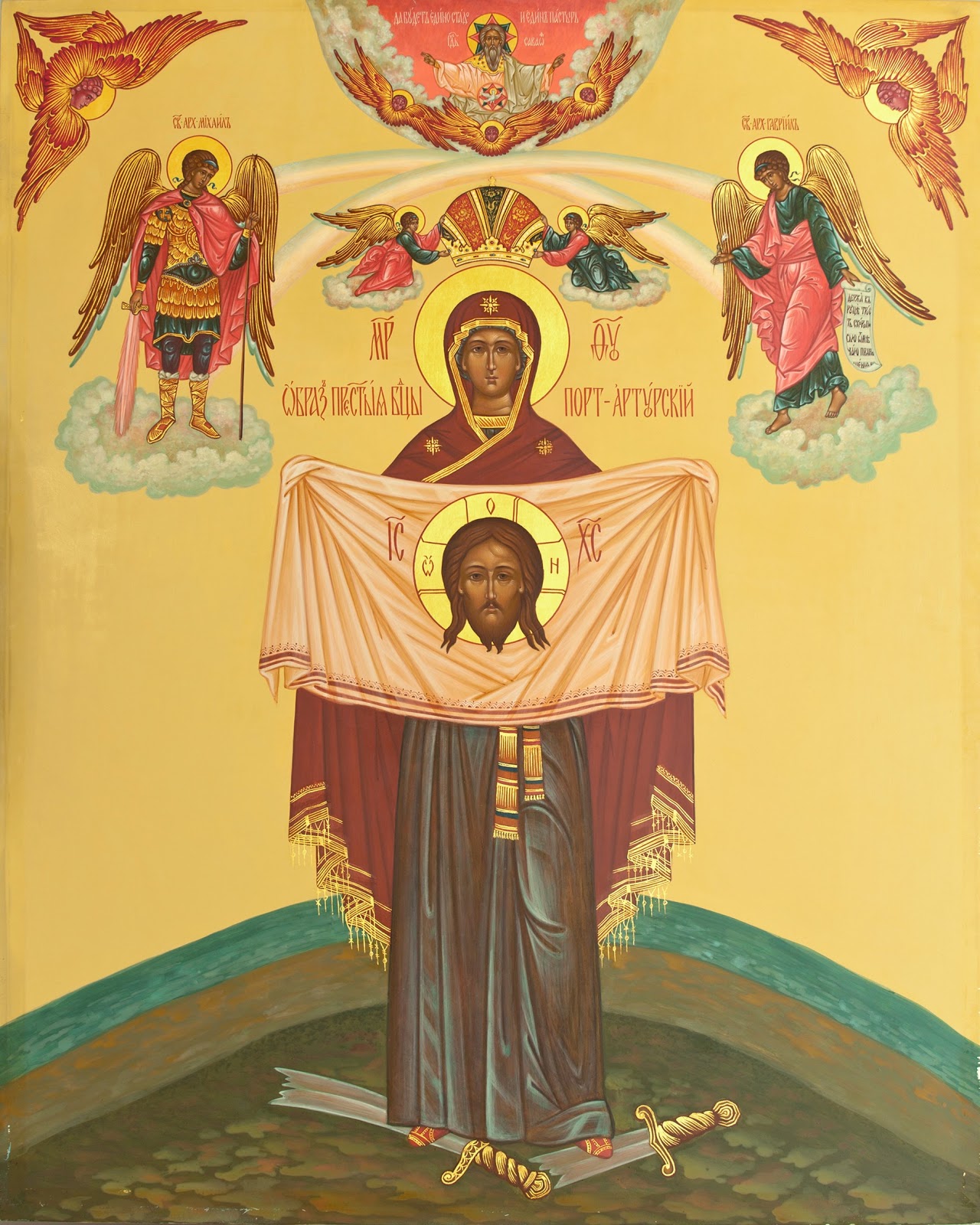
This icon is also unique because it was the first
image of the Most Holy Theotokos to be revealed to Christians in the 20th
century. A sailor named Theodore Katansky who visited Kiev Caves Lavra in 1903
told other believers about it. He had been a hero of the defense of Sevastopol
during the Crimean War.
The old sailor related that he had seen the Mother
of God with an image of Christ Not-Made-By-Hands in a dream after praying for
Russian sailors who served in the Far East.
The Blessed Virgin appeared to him surrounded by
Angels and saints. Our Lady comforted the sailor and told him that Russia was
soon to enter into a devastating and difficult war, full of losses and
troubles, along its coastal borders. That was why She ordered to have Her icon
painted and sent to Port Arthur. Brought to the walls of the distant city and
naval base, the holy image was meant to help the Orthodox triumph over the
pagans and inspire Russian soldiers and sailors to fight bravely.

The icon was painted for free by P.F. Stronde, a
painter from Kiev, in 1904, using materials purchased for donated money and
following the old sailor’s instructions. There was an inscription around the
image, which read, “Blessings and wishes of victory to the Christ-loving army
of the Far Russia from holy monasteries of Kiev, 10 000 believers and friends.”
The icon was sent to Saint Petersburg.
Unfortunately, military officials in the capital slowed down its delivery to
the fortress. The image arrived in the Far East when Port Arthur had already
been blocked by the Japanese. After a short stay in Vladivostok, it was sent to
General Kuropatkin’s headquarters. Due to the hasty retreat, Port Arthur icon
and several other holy objects were lost.
The image was miraculously re-discovered in 1998.
It was bought by a group of Russian pilgrims in an antiques shop in Jerusalem
on Via Dolorosa. It remains unclear how and when it got there. The
wonder-working icon returned to Vladivostok after restoration. It stays in the
Cathedral in honor of Holy Protection of the Mother of God in this Russian city.

തോമാശ്ലീഹാ ഭാരതത്തിലെത്തിയതിന് തെളിവുകള് , ബിഷപ് മാര് ജോസഫ് പാംബ്ലാനി .
ചരിത്രത്തിന് ആഖ്യാതാവിന്റെ പക്ഷത്തിന് അനുസരിച്ചുള്ള അര്ത്ഥതലങ്ങളും അനുബന്ധങ്ങളും ഉണ്ടാകാം (polyhedron intelligibility) എന്നത് സത്യമാണ്.

തോമാശ്ലീഹായുടെ ഭാരതാഗമനത്തെ നിഷേധിക്കുന്ന കേരളചരിത്രകാരന്മാരില് പ്രധാനികള് ഇളംകുളം കുഞ്ഞന്പിള്ള, ഡോ. എം.ജി.എസ്. നാരായണന്, ജോസഫ് ഇടമറുക്, ഡോ. രാജന് ഗുരുക്കള് തുടങ്ങിയവരാണ്. ഇവരുടെ വാദമുഖങ്ങള് പ്രധാനമായും നാലെണ്ണമാണ്:
1. ക്രിസ്തുവര്ഷത്തിന്റെ ആദ്യദശകത്തില് പലസ്തീനായില്നിന്ന് ഒരാള് കേരളത്തിലെത്തി ഇവിടെ സുവിശേഷം പ്രസംഗിച്ചു എന്നുപറയുന്നത് ചരിത്ര വസ്തുതകളുമായി ഒത്തുപോകുന്നില്ല എന്നതാണ് ആദ്യ ആരോപണം. കേരളതീരത്ത് എ.ഡി. ഒന്നാം നൂറ്റാണ്ടില് മനുഷ്യവാസംതന്നെ ഇല്ലായിരുന്നു എന്നു വാദിക്കുന്നവരുമുണ്ട്.
2. തോമാശ്ലീഹായുടെ ഭാരത പ്രേഷിതത്വത്തിന് 15-ാം നൂറ്റാണ്ടിനു മുന്പുള്ള ചരിത്രപരമായ തെളിവുകളില്ല. തോമാചരിതം പോര്ട്ടുഗീസുകാരുടെ സൃഷ്ടിയാണ് എന്നത് ഒരു വാദം.
3. മലബാര് തീരത്ത് ഒന്നാം നൂറ്റാണ്ടില് നമ്പൂതിരിമാര് (സവര്ണ്ണ ബ്രാഹ്മണര്) ഉണ്ടായിരുന്നില്ല. ബ്രാഹ്മണ കുടിയേറ്റം ക്രിസ്തുവര്ഷം ഏഴാം നൂറ്റാണ്ടോടുകൂടിയാണ് കേരളത്തില് സംഭവിക്കുന്നത് എന്നതാണ് മറ്റൊരു ആരോപണം.
4. തോമ്മാശ്ലീഹായുടെ പേരുമായി ബന്ധപ്പെട്ട് പറയപ്പെടുന്ന ഗുണ്ടഫര് രാജാവ് അഫ്ഗാന് പ്രദേശത്തെ രാജാവായിരുന്നു എന്നതാണ് മറ്റൊരു വാദം.
തോമാശ്ലീഹായുടെ ഭാരതപ്രേഷിതത്വത്തെ എതിര്ക്കുന്ന പാശ്ചാത്യരുടെ പ്രധാനവാദം ഏഴാം നൂറ്റാണ്ടോടുകൂടി പേര്ഷ്യയില്നിന്നാണ് മാര്തോമ്മാ ക്രിസ്ത്യാനികള് എന്നപേരില് ഒരുവിഭാഗം തെക്കേ ഇന്ത്യയിലെത്തിയത് എന്നാണ് (J.W. Zelazny, The Tradition of St. Thomas Mission to India in OCC 3 (2011) 165-180). സെലൂഷ്യ - സ്റ്റെസിഫോണിലെ കാതോലിക്കോസിന്റെ കീഴിലായിരുന്ന ക്രൈസ്തവരായിരുന്നതിനാല് ഇവര് അരമായ സംസ്കാരം മുറുകെപിടിച്ച പൗരസ്ത്യ സുറിയാനിക്കാരായിരുന്നു എന്നും വാദിക്കുന്നു. പൗരസ്ത്യ സുറിയാനി സഭയുടെ കേന്ദ്രമായിരുന്ന ഏദേസ്സാ സില്ക്ക് റൂട്ടിലെ പ്രധാന വ്യാപാര കേന്ദ്രമായിരുന്നു എന്ന ചരിത്രവസ്തുതയില്നിന്നാണ് ഈ വാദം കരുപ്പിടിപ്പിക്കപ്പെടുന്നത്. മേല്പറഞ്ഞ വാദഗതികളെല്ലാംതന്നെ തികച്ചും ബാലിശവും നിക്ഷിപ്ത താത്പര്യങ്ങളാല് പ്രേരിതവുമാണെന്ന് സൂക്ഷ്മാപഗ്രഥനത്തില് മനസിലാകും.
ഒന്നാം നൂറ്റാണ്ടിനു മുമ്പുതന്നെ ഇന്ത്യയിലേയ്ക്ക് പാലസ്തീനായില്നിന്ന് കപ്പല്മാര്ഗ്ഗം സ്ഥിരയാത്രാ സംവിധാനം ഉണ്ടായിരുന്നു. അലക്സാണ്ട്രിയായില്നിന്ന് കെയ്റോയ്ക്ക് 420 മൈല് തെക്കുള്ള കോപ്റ്റോസ് പട്ടണത്തില് കടല്മാര്ഗ്ഗം എത്തുകയും തുടര്ന്ന് കരമാര്ഗ്ഗം ചെങ്കടല് തീരത്ത് മിയോസ് ഹോര്മോസ് തുറമുഖത്തെത്തി വീണ്ടും കടല് മാര്ഗം ഇന്ത്യയിലേക്ക് എത്തിച്ചേരാനും കഴിയുമായിരുന്നു. പ്രതിവര്ഷം ശരാശരി 120 കപ്പലുകള് ഈ മാര്ഗ്ഗത്തിലൂടെ ഇന്ത്യന് തീരത്തേക്ക് പുറപ്പെട്ടിരുന്നതായി കേംബ്രിഡ്ജ് ഗവേഷകര് പ്ലീനിയുടെയും (6.2) സ്ട്രെബോയുടെയും (2.5.12) രചനകളെ ആധാരമാക്കി സമര്ത്ഥിക്കുന്നുണ്ട് (J. O. Thomson, History of Asian Geography, p. 174).
ആരംഭത്തില് സിന്ധുനദീതടത്തിലേക്ക് പുറപ്പെട്ടിരുന്ന ഈ കപ്പലുകള് പില്ക്കാലത്ത് മുസ്സീരിസ്സിലേക്കും (കൊടുങ്ങല്ലൂര്) പോയിരുന്നതായും ഗവേഷകര് സമര്ത്ഥിക്കുന്നുണ്ട്. ടോളമിയുടെ ചരിത്ര ഗ്രന്ഥങ്ങളിലും റോമന് കപ്പലുകള് ക്രിസ്തുവര്ഷം ഒന്നാം നൂറ്റാണ്ടില് മുസീരിസിലേക്ക് വന്നതായി സാക്ഷ്യങ്ങളുണ്ട്. ഒന്നാം നൂറ്റാണ്ടില് ജനിക്കപ്പെട്ടതായി കരുതപ്പെടുന്ന വിഖ്യാത ഗ്രേക്കോ-റോമന് കൃതിയായ പെരിപ്ലസ് മാരി എരിത്രോയില് മുസീരിസ് തുറമുഖത്തിന്റെ വ്യാവസായിക പ്രാധാന്യം സമര്ത്ഥിക്കുന്നുണ്ട്.
മുസീരിസിന്റെ വാണിജ്യ പ്രാധാന്യമാണ് യഹൂദമതത്തെയും ആര്യന്മാരെയും കേരളത്തിലേക്ക് ആകര്ഷിച്ചത്. സംഘകാലകൃതികളിലെ മുചീരിയും വാത്മീകി രാമായണത്തിലെ മുരചീപത്തനവും കാളിദാസകാവ്യമായ രഘുവംശത്തിലെ മുരചീമാരുതവും മുസീരിസ് തന്നെയാണെന്ന് കരുതപ്പെടുന്നു. ഇന്ത്യാ ഗവണ്മെന്റ് അടുത്തകാലത്തു നടത്തിയ പട്ടണംഗവേഷണങ്ങളില് കൊടുങ്ങല്ലൂരില്നിന്നും കണ്ടെത്തിയ റോമന് നാണയങ്ങള് ഈ ചരിത്ര വസ്തുത ശരിവയ്ക്കുന്നതാണ്. കൊടുങ്ങല്ലൂരും പരിസരങ്ങളിലും നടത്തുന്ന ഭൂഗര്ഭ ഗവേഷണങ്ങള് തോമാശ്ശീഹയുടെ ഭാരതാഗമനത്തിന് കൂടുതല് ശക്തമായ തെളിവുകള് പുറത്തുകൊണ്ടുവരാന് സാധ്യതയുണ്ട.്
മുസീരിസിന്റെ വാണിജ്യ പ്രാധാന്യമാണ് യഹൂദമതത്തെയും ആര്യന്മാരെയും കേരളത്തിലേക്ക് ആകര്ഷിച്ചത്. സംഘകാലകൃതികളിലെ മുചീരിയും വാത്മീകി രാമായണത്തിലെ മുരചീപത്തനവും കാളിദാസകാവ്യമായ രഘുവംശത്തിലെ മുരചീമാരുതവും മുസീരിസ് തന്നെയാണെന്ന് കരുതപ്പെടുന്നു. ഇന്ത്യാ ഗവണ്മെന്റ് അടുത്തകാലത്തു നടത്തിയ പട്ടണംഗവേഷണങ്ങളില് കൊടുങ്ങല്ലൂരില്നിന്നും കണ്ടെത്തിയ റോമന് നാണയങ്ങള് ഈ ചരിത്ര വസ്തുത ശരിവയ്ക്കുന്നതാണ്. കൊടുങ്ങല്ലൂരും പരിസരങ്ങളിലും നടത്തുന്ന ഭൂഗര്ഭ ഗവേഷണങ്ങള് തോമാശ്ശീഹയുടെ ഭാരതാഗമനത്തിന് കൂടുതല് ശക്തമായ തെളിവുകള് പുറത്തുകൊണ്ടുവരാന് സാധ്യതയുണ്ട.്
കേരളത്തിലെ യഹൂദര് പരമ്പരാഗതമായി സൂക്ഷിച്ചുപ്പോരുന്ന രേഖകളനുസരിച്ച് എ.ഡി. 68 ല് കേരളത്തിലെത്തിയ യഹൂദര് ഇവിടെ ക്രിസ്ത്യാനികളെ കണ്ടതായുള്ള സാക്ഷ്യം ശ്രീധരമേനോന് കേരളചരിതത്തില് നല്കുന്നുണ്ട് (ു. 134). അതിനാല് എ.ഡി ഒന്നാം നൂറ്റാണ്ടില് കേരളതീരത്ത് മനുഷ്യവാസമില്ലായിരുന്നെന്നോ ഉണ്ടായിരുന്നവര് ഭാഷ വശമില്ലാത്ത കാട്ടുജാതികളായിരുന്നെന്നോ വാദിച്ച് തോമാശ്ലീഹായുടെ കേരളപ്രേഷിതത്വം ഖണ്ഡിക്കുന്നവരെ ചരിത്രപണ്ഡിതര് എന്നുവിളിക്കാന് വിഷമമുണ്ട്.
എ.ഡി. ഒന്നാംനൂറ്റാണ്ടില് തമിഴകം എന്ന പൊതുപ്പേരില് അറിയപ്പെട്ടിരുന്ന തെക്കേ ഇന്ത്യ ചേരം, ചോളം, പാണ്ഡ്യം രാജ്യങ്ങള് ചേര്ന്നതായിരുന്നു എന്നും ഇതില് കേരളക്കര ചേര രാജ്യത്തിന്റെ ഭാഗമായിരുന്നു എന്നുമുള്ള പദ്മനാഭമേനോന്റെ നിരീക്ഷണം (History of Kerala, Vol. 1, p.100) വസ്തുതാപരമാണ്. ഒന്നാം നൂറ്റാണ്ടിലെ ഇന്ത്യയില് ആര്യാവര്ത്തം”എന്നറിയപ്പെടുന്ന ഉത്തരേന്ത്യയും ചേരനാട്എന്നറിയപ്പെടുന്ന കേരളവും ദക്ഷിണപഥം എന്നറിയപ്പെടുന്ന ഡെക്കാനും ഉള്പ്പെട്ടിരുന്നു. ആര്യാവര്ത്തത്തില് തക്ഷശിലയും ഡക്കാനില് ബറൂച്ചും ചേരനാട്ടില് മുസീരിസും ആയിരുന്നു വാണിജ്യകേന്ദ്രങ്ങള്.
സംഘകാല രചനകളായ എട്ടുതൊകൈ, പുറനാനൂറ്, അകനാനൂറ് എന്നീ കൃതികള് ഈ കാലഘട്ടത്തിലെ കേരള സാമൂഹികതയുടെ ഏകദേശ ചിത്രം വരച്ചുകാട്ടുന്നു.ബി.സി. ഇരുപതാം നൂറ്റാണ്ടോടെ ഇന്ത്യയിലെത്തിയ ആര്യന്മാര് സിന്ധുനദീതടത്തിലാണ് പ്രധാനമായും അധിവസിച്ചിരുന്നത്. ബി.സി. അഞ്ചാം നൂറ്റാണ്ടു മുതല് തമിഴകത്ത് (കേരളമുള്പ്പടെ) ആര്യന്മാരുടെ (ബ്രാഹ്മണരുടെ) സ്വാധീനമുണ്ടായിരുന്നു.
ബി.സി. ആറാം നൂറ്റാണ്ടു മുതലെങ്കിലും യഹൂദ കച്ചവടക്കാര് ദക്ഷിണേന്ത്യയിലെത്തിയിരുന്നതായി കരുതപ്പെടുന്നു. എ.ഡി. ഒന്നാം നൂറ്റാണ്ടില് യഹൂദരും ബ്രാഹ്മണരും തദ്ദേശീയരുമായി ഇടകലര്ന്ന് ജീവിച്ചിരുന്ന സാമൂഹിക ക്രമമാണ് കേരളത്തില് നിലനിന്നിരുന്നത്. അച്യുതമേനോന്റെ കൊച്ചിന് സ്റ്റേറ്റുമാന്വലില് ഇതിന്റെ വിശദാംശങ്ങള് ലഭ്യമാണ്.
ഇക്കാലഘട്ടത്തില് ജാതി വ്യവസ്ഥയോ, ചാതുര്വണ്യമോ കേരള സമൂഹത്തില് ശക്തമായിരുന്നില്ല. അതിനാല് എ.ഡി. 52 ലെ തോമാശ്ലീഹായുടെ കേരളാഗമനം ചരിത്രവസ്തുതകളുമായി തികച്ചും ഒത്തുപോകുന്നതാണ്.
ബി.സി. ആറാം നൂറ്റാണ്ടു മുതലെങ്കിലും യഹൂദ കച്ചവടക്കാര് ദക്ഷിണേന്ത്യയിലെത്തിയിരുന്നതായി കരുതപ്പെടുന്നു. എ.ഡി. ഒന്നാം നൂറ്റാണ്ടില് യഹൂദരും ബ്രാഹ്മണരും തദ്ദേശീയരുമായി ഇടകലര്ന്ന് ജീവിച്ചിരുന്ന സാമൂഹിക ക്രമമാണ് കേരളത്തില് നിലനിന്നിരുന്നത്. അച്യുതമേനോന്റെ കൊച്ചിന് സ്റ്റേറ്റുമാന്വലില് ഇതിന്റെ വിശദാംശങ്ങള് ലഭ്യമാണ്.
ഇക്കാലഘട്ടത്തില് ജാതി വ്യവസ്ഥയോ, ചാതുര്വണ്യമോ കേരള സമൂഹത്തില് ശക്തമായിരുന്നില്ല. അതിനാല് എ.ഡി. 52 ലെ തോമാശ്ലീഹായുടെ കേരളാഗമനം ചരിത്രവസ്തുതകളുമായി തികച്ചും ഒത്തുപോകുന്നതാണ്.
പോര്ച്ചുഗീസ് സൃഷ്ടിയോ?
മറ്റൊരു പ്രധാന ആരോപണം പോര്ച്ചുഗീസുകാരുടെ ആഗമനത്തോടെയാണ് തോമാശ്ലീഹായുടെ ഭാരത പ്രേഷിതത്വം എന്ന ഐതിഹ്യം പ്രചരിച്ചത് എന്നുള്ളതാണ്. ജോസഫ് ഇടമറുക്, രാജന് ഗുരുക്കള് എന്നിവര് ഈ വിചിത്രവാദം ഉന്നയിക്കുന്നവരില് പ്രമുഖരാണ്. തോമാശ്ലീഹാ പോര്ച്ചുഗല് രാജ്യത്തിന്റെ മധ്യസ്ഥനായിരുന്നു എന്നതാണ് തങ്ങളുടെ വാദത്തിന് പിന്ബലമായി ഇവര് അവതരിപ്പിക്കുന്നത് (ഇടമറുക്, സെന്റ് തോമസ് ഒരു കെട്ടുകഥ: ു. 140).
മറ്റൊരു പ്രധാന ആരോപണം പോര്ച്ചുഗീസുകാരുടെ ആഗമനത്തോടെയാണ് തോമാശ്ലീഹായുടെ ഭാരത പ്രേഷിതത്വം എന്ന ഐതിഹ്യം പ്രചരിച്ചത് എന്നുള്ളതാണ്. ജോസഫ് ഇടമറുക്, രാജന് ഗുരുക്കള് എന്നിവര് ഈ വിചിത്രവാദം ഉന്നയിക്കുന്നവരില് പ്രമുഖരാണ്. തോമാശ്ലീഹാ പോര്ച്ചുഗല് രാജ്യത്തിന്റെ മധ്യസ്ഥനായിരുന്നു എന്നതാണ് തങ്ങളുടെ വാദത്തിന് പിന്ബലമായി ഇവര് അവതരിപ്പിക്കുന്നത് (ഇടമറുക്, സെന്റ് തോമസ് ഒരു കെട്ടുകഥ: ു. 140).
എന്നാല് പോര്ച്ചുഗലിന്റെ മധ്യസ്ഥ, ആരംഭം മുതലേ പരിശുദ്ധ മറിയമായിരുന്നു എന്ന സത്യം തങ്ങളുടെ നുണപ്രചരണത്തിനായി ഇവര് സൗകര്യപൂര്വ്വം മറന്നു. ആദ്യനൂറ്റാണ്ടുകളിലെ സഭാപിതാക്കന്മാരുടെ സാക്ഷ്യങ്ങളെ സഭയുടെ രേഖകളായി അവഗണിച്ചാല്പോലും വെനീഷ്യന് സഞ്ചാരിയായ മാര്ക്കോപോളൊയുടെ (1254-1324) സാക്ഷ്യങ്ങള് ഇവര്ക്കു നിഷേധിക്കാനാവില്ല. തമിഴ്നാടിന്റെ കിഴക്കേ തീരത്ത് ക്രിസ്തുശിഷ്യനായ തോമാശ്ലീഹായുടെ ഖബറിടം കണ്ടതായും ശ്ലീഹാ മരിച്ചുവീണ സ്ഥലത്തെ ചുവന്ന മണ്ണ് വിശ്വാസികള് രോഗശാന്തിക്കായി ഉപയോഗിച്ചിരുന്നതായും മാര്ക്കോപോളോ സാക്ഷ്യപ്പെടുത്തുന്നുണ്ട് (Travells of Marcopolo, p. 284).
വാസ്ഗോഡിഗാമ കേരളത്തിലെത്തിയപ്പോള് ജൂലൈ മൂന്ന് തോമാശ്ലീഹായുടെ ദുക്റാന തിരുനാളായി തദ്ദേശീയ ക്രൈസ്തവര് ആഘോഷിച്ചിരുന്നതായി മനസ്സിലാക്കി എന്നതിന് ചരിത്ര സാക്ഷ്യങ്ങളുണ്ട് (Bernard Thoma: Brief Sketch of St. Thomas Christians, p. 138).
വാസ്ഗോഡിഗാമ കേരളത്തിലെത്തിയപ്പോള് ജൂലൈ മൂന്ന് തോമാശ്ലീഹായുടെ ദുക്റാന തിരുനാളായി തദ്ദേശീയ ക്രൈസ്തവര് ആഘോഷിച്ചിരുന്നതായി മനസ്സിലാക്കി എന്നതിന് ചരിത്ര സാക്ഷ്യങ്ങളുണ്ട് (Bernard Thoma: Brief Sketch of St. Thomas Christians, p. 138).
തോമാശ്ലീഹായുടെ ഭാരത പ്രേഷിതത്വത്തിന് പതിനഞ്ചാം നൂറ്റാണ്ടിനു മുമ്പ് തെളിവുകളില്ല എന്നു വാദിക്കുന്നവര് ചരിത്രം പഠിക്കാത്തവരോ ഈ വിഷയത്തില് വേണ്ടത്ര ഗൃഹപാഠം ചെയ്യാത്തവരോ ആണ്. ക്രിസ്തുവര്ഷം 200-ല് രചിക്കപ്പെട്ട ശ്ലീഹന്മാരുടെ പ്രബോധനം”എന്ന ഗ്രന്ഥത്തില് തോമാശ്ലീഹായുടെ ഇന്ത്യയിലെ പ്രേഷിത പ്രവര്ത്തനം പരാമര്ശിക്കുന്നുണ്ട്. എദേസായിലെ വി. എഫ്രേമിന്റെ (എ.ഡി. 306-378) രചനകളില് തോമാശ്ലീഹായുടെ ഇന്ത്യയിലെ പ്രേഷിത പ്രവര്ത്തനവും രക്തസാക്ഷിത്വവും വിവരിക്കുന്നതോടൊപ്പം ശ്ലീഹായുടെ തിരുശ്ശേഷിപ്പുകളെക്കുറിച്ചും പറയുന്നുണ്ട് (Sancti Eporaem Syri Hymni, IV. col. 693þ-708). വി. ഗ്രിഗറി നസിയാന്സന്റെ (324-390) ആര്യന്മാര്ക്കെതിരെയുള്ള പ്രഭാഷണ ഗ്രന്ഥത്തിലും (23:11) ശ്ലീഹായുടെ ഭാരതാഗമനം പരാമര്ശിക്കുന്നു.
തീബന് പണ്ഡിതനായ ഒരു അജ്ഞാത ഗ്രന്ഥകാരന്റെ De Moribus Brahmanorum എന്ന ഗ്രീക്ക് ഗ്രന്ഥം ലത്തീനിലേക്ക് വിവര്ത്തനം ചെയ്ത വി. അംബ്രോസ് (ഏ.ഡി 333-397) പ്രസ്തുത ഗ്രന്ഥത്തിന്റെ അടിസ്ഥാനത്തില് വി. തോമാശ്ലീഹാ തെക്കെ ഇന്ത്യയിലെ മുസ്സീരീസ് തുറമുഖത്ത് വന്ന് സുവിശേഷമറിയിച്ചതായി വ്യക്തമാക്കുന്നുണ്ട് (PL 17. 1169).. വിഖ്യാത പണ്ഡിതനായ വിശുദ്ധ ജറോമിന്റെ രചനകളില് ആദ്യം ഉത്തരേന്ത്യയിലും പിന്നീട് ദക്ഷിണേന്ത്യയിലും തോമാശ്ലീഹാ നടത്തുന്ന പ്രേഷിത പ്രവൃത്തികള് വിവരിക്കുന്നുണ്ട് (Epist. 125, PL 22, 1073-þ1074).
സഭാപിതാവായ യൗസേബിയൂസിന്റെ രചനകളില് രണ്ടാം നൂറ്റാണ്ടിന്റെ മധ്യത്തോടെ ഭാരതത്തില് പര്യടനം നടത്തിയ പന്തേനൂസിന്റെ നിരീക്ഷണങ്ങള് ഉള്പ്പെടുത്തുന്നുണ്ട്. വി. മത്തായിയുടെ സുവിശേഷത്തിന്റെ ഹീബ്രു മൂലകൃതി സൂക്ഷിച്ചിരുന്ന ഒരു ക്രൈസ്തവ സമൂഹത്തെ ഭാരതത്തില് കണ്ടതായാണ് യൗസേബിയൂസ് സാക്ഷ്യപ്പെടുത്തുന്നത് (Hist. Eccl. 10.2-þ3). . എ.ഡി. 325 ല് നടന്ന നിഖ്യാ സൂനഹദോസിന്റെ ഇന്ത്യയില് നിന്നുള്ള ഒരു യോഹന്നാന് മെത്രാന് പങ്കെടുത്തതായുള്ള സാക്ഷ്യവും ഇതിനോട് ചേര്ത്തുവായിക്കേണ്ടതാണ്. മെഡിറ്ററേനിയന് തീരത്തെ ചൈനയെയും ഇന്ത്യയെയും തമ്മില് ബന്ധിപ്പിക്കുന്ന കരമാര്ഗ്ഗമുണ്ടായിരുന്ന സില്ക്ക് റൂട്ടിന് സമാന്തരമായി കടല്മാര്ഗം ഒരു മണ്സൂണ് റൂട്ട്” ഉണ്ടായിരുന്നതായി ചരിത്രകാരന്മാര് സാക്ഷ്യപ്പെടുത്തുന്നുണ്ട്. പന്തേനൂസ് ഇന്ത്യയില് കണ്ടതായി പറയപ്പെടുന്ന അരമായ ഭാഷയിലെ (ഹീബ്രു ലിപിയില്) സുവിശേഷം അരമായനായ ഒരു ക്രിസ്തുശിഷ്യന്റെ പ്രേഷിത പ്രവര്ത്തനംമൂലം സംഭവിച്ചതാണെന്ന് ന്യായമായും അനുമാനിക്കാം. ഭൗമശാസ്ത്രജ്ഞനായിരുന്ന സെവിലി യിലെ ഇസിഡോര് എ.ഡി. 638-ല് രചിച്ച ഗ്രന്ഥത്തില് (De Ortu et Obitu Patrum) തോമാശ്ലീഹാ പാര്ത്തിയായിലും പേര്ഷ്യയിലും തുടര്ന്ന് ഇന്ത്യയിലും സുവിശേഷം പ്രസംഗിച്ചതായും ഇന്ത്യയിലെ കലാമിനാ (മദ്രാസ്) നഗരത്തില്വച്ച് കുന്തത്താല് കുത്തിക്കൊല്ലപ്പെട്ടതായും രേഖപ്പെടുത്തുന്നുണ്ട് (ജഘ 83,152).
ബ്രാഹ്മണ പാരമ്പര്യം
തോമാശ്ലീഹായുടെ കേരള പ്രേഷിതത്വത്തെ നിഷേധിക്കാന് ആഗ്രഹിക്കുന്നവര് ഉന്നയിക്കുന്ന ഏറ്റവും വലിയ ആരോപണം തോമാശ്ലീഹാ ബ്രാഹ്മണരെ സ്നാനപ്പെടുത്തി എന്ന വാദത്തിന്റെ നിരര്ത്ഥകതയാണ്. ക്രിസ്തുവര്ഷത്തിന്റെ ആദ്യശതകത്തില് കേരളത്തില് ബ്രാഹ്മണര് ഇല്ലായിരുന്നു എന്നതിനാല് തോമാശ്ലീഹാ ബ്രാഹ്മണരെ സ്നാനപ്പെടുത്തി ക്രിസ്ത്യാനികളാക്കി എന്നത് അബദ്ധമാണ് എന്നതാണ് ഇവരുടെ വാദത്തിന്റെ പൊരുള്.
എ.ഡി. ഏഴാം നൂറ്റാണ്ടോടെയാണ് കേരളത്തിലേയ്ക്ക് ബ്രാഹ്മണ കുടിയേറ്റം ഉണ്ടായത് എന്ന നിഗമനമാണ് മലബാര് മാന്വലില് വില്യം ലോഗന് അവതരിപ്പിക്കുന്നത് (Manual of Malabar, vol. I. p. 275). ഈ വാദത്തിന് ഉപോദ്ബലകമായി ലോഗന് ചൂണ്ടിക്കാട്ടുന്നത് ചൈനീസ് സഞ്ചാരിയായ ഹുയാന്സാങിന്റെ (629-645) യാത്രാവിവരണത്തില് കേരളത്തിലെ ബ്രാഹ്മണരെക്കുറിച്ച് പരാമര്ശിക്കുന്നില്ല എന്നതാണ്. എന്നാല്, ലോഗന്റെ വാദത്തെ കെ.പി. പദ്മനാഭമേനോന് തന്റെ കേരള ചരിതത്തില് ഖണ്ഡിക്കുന്നുണ്ട്. ഹ്യുയാന്സാങ് സന്ദര്ശിച്ച സ്ഥലങ്ങളില് ബ്രാഹ്മണ സ്വാധീനം കുറവായിരുന്നു എന്നതില് കവിഞ്ഞ നിഗമനങ്ങള് നടത്തിയതില് ലോഗന് തെറ്റുപറ്റിയെന്നാണ് അദ്ദേഹം സമര്ത്ഥിക്കുന്നത് (ഒശേെീൃ്യ ീള ഗലൃമഹമ, ഢീഹ. ക, ു. 42-43). ശ്രീധരമേനോന്റെ കേരളചരിത്രവും ഇതേ നിലപാടാണ് സ്വീകരിക്കുന്നത്.
തോമാശ്ലീഹായുടെ കേരള പ്രേഷിതത്വത്തെ നിഷേധിക്കാന് ആഗ്രഹിക്കുന്നവര് ഉന്നയിക്കുന്ന ഏറ്റവും വലിയ ആരോപണം തോമാശ്ലീഹാ ബ്രാഹ്മണരെ സ്നാനപ്പെടുത്തി എന്ന വാദത്തിന്റെ നിരര്ത്ഥകതയാണ്. ക്രിസ്തുവര്ഷത്തിന്റെ ആദ്യശതകത്തില് കേരളത്തില് ബ്രാഹ്മണര് ഇല്ലായിരുന്നു എന്നതിനാല് തോമാശ്ലീഹാ ബ്രാഹ്മണരെ സ്നാനപ്പെടുത്തി ക്രിസ്ത്യാനികളാക്കി എന്നത് അബദ്ധമാണ് എന്നതാണ് ഇവരുടെ വാദത്തിന്റെ പൊരുള്.
എ.ഡി. ഏഴാം നൂറ്റാണ്ടോടെയാണ് കേരളത്തിലേയ്ക്ക് ബ്രാഹ്മണ കുടിയേറ്റം ഉണ്ടായത് എന്ന നിഗമനമാണ് മലബാര് മാന്വലില് വില്യം ലോഗന് അവതരിപ്പിക്കുന്നത് (Manual of Malabar, vol. I. p. 275). ഈ വാദത്തിന് ഉപോദ്ബലകമായി ലോഗന് ചൂണ്ടിക്കാട്ടുന്നത് ചൈനീസ് സഞ്ചാരിയായ ഹുയാന്സാങിന്റെ (629-645) യാത്രാവിവരണത്തില് കേരളത്തിലെ ബ്രാഹ്മണരെക്കുറിച്ച് പരാമര്ശിക്കുന്നില്ല എന്നതാണ്. എന്നാല്, ലോഗന്റെ വാദത്തെ കെ.പി. പദ്മനാഭമേനോന് തന്റെ കേരള ചരിതത്തില് ഖണ്ഡിക്കുന്നുണ്ട്. ഹ്യുയാന്സാങ് സന്ദര്ശിച്ച സ്ഥലങ്ങളില് ബ്രാഹ്മണ സ്വാധീനം കുറവായിരുന്നു എന്നതില് കവിഞ്ഞ നിഗമനങ്ങള് നടത്തിയതില് ലോഗന് തെറ്റുപറ്റിയെന്നാണ് അദ്ദേഹം സമര്ത്ഥിക്കുന്നത് (ഒശേെീൃ്യ ീള ഗലൃമഹമ, ഢീഹ. ക, ു. 42-43). ശ്രീധരമേനോന്റെ കേരളചരിത്രവും ഇതേ നിലപാടാണ് സ്വീകരിക്കുന്നത്.
ഉത്തരേന്ത്യയിലെ ഗുപ്താ ഭരണകാലത്തിന്റെ (എ.ഡി. 240-590) ആരംഭത്തിനു മുന്പേ തെക്കേ ഇന്ത്യയിലേക്ക് ആര്യന്മാരുടെ സംഘടിത കുടിയേറ്റങ്ങള് നടന്നിരുന്നതായി ശ്രീധരമേനോനും കേരളചരിത്ര നിഘണ്ടു രചിച്ച പ്രഫ. എസ്.കെ. വസന്തനും സമര്ത്ഥിക്കുന്നുണ്ട്. പി.കെ. ബാലകൃഷ്ണന് രചിച്ച ജാതിവ്യവസ്ഥയും കേരളവും എന്ന ഗ്രന്ഥത്തില് കേരളത്തിലേക്കുള്ള നമ്പൂതിരിമാരുടെ കുടിയേറ്റം ചെറുതും വലുതുമായ സംഘങ്ങളായി അനേകം നൂറ്റാണ്ടുകള്കൊണ്ട് സംഭവിച്ചതാണെന്ന് നിരീക്ഷിക്കുന്നുണ്ട്.
മിലാനിലെ അംബ്രോസിന്റെ (333-397) വിവര്ത്തന കൃതിയായ ബ്രാഹ്മണരുടെ ചര്യകള്-(De Moribus Brachmanorum) എന്ന കൃതിയില് മുസീരിസ് തുറമുഖത്തോടനുബന്ധിച്ച് വസിച്ചിരുന്ന ബ്രാഹ്മണ സമൂഹങ്ങളെക്കുറിച്ച് സൂചന നല്കുന്നുണ്ട്. ടിയാനായിലെ അപ്പോളോണിയൂസിന്റെ ഇന്ത്യയിലേക്കുള്ള യാത്രാവിവരണത്തില് ഫിസോണ് നദി (ഗംഗ) തടത്തിലും തെക്കെ ഇന്ത്യയിലെ മൂസീരിസിലുമുള്ള ബ്രാഹ്മണരുടെ ഇടയില് തോമാശ്ലീഹാ സുവിശേഷമറിയിച്ചതായി സാക്ഷ്യപ്പെടുത്തുന്നുണ്ട്. വിശുദ്ധ ജറോം (342-420) ഈ യാത്രാവിവരണം പരാമര്ശിക്കുന്നുണ്ട് (ജഘ 14-1143). എ.ഡി. ഒന്നാം നൂറ്റാണ്ടില് കേരളത്തില് ബ്രാഹ്മണര് ഉണ്ടായിരുന്നു എന്നു കരുതാന് ഒട്ടേറെ തെളിവുകള് ഉണ്ടെന്നു സാരം. മറിച്ച് തെളിയിക്കാന് യാതൊരു ചരിത്ര രേഖയും നിലവിലില്ല എന്നതാണ് സത്യം. ജാതിയില് മേല്ക്കോയ്മ അവകാശപ്പെടുന്ന സംഘടിത ശക്തിയായി ബ്രാഹ്മണ സമൂഹം കേരളത്തില് സ്വാധീനമുറപ്പിച്ചത് നാലാം നൂറ്റാണ്ടിന്റെ അവസാനത്തോടെയാകാനാണ് സാധ്യത. ആദ്യ ശതകത്തില് കേരളത്തിലുണ്ടായിരുന്ന ബ്രാഹ്മണര് ജാതിചിന്ത കൂടാതെ ഈ നാട്ടിലെ സംസ്കാരവുമായി ഇണങ്ങി ജീവിച്ചിരിക്കാനാണ് സാധ്യത.
തോമാശ്ലീഹാ കേരളത്തില്വന്ന് ഉന്നതകുലജാതന്മാരായ ബ്രാഹ്മണരെ മാത്രമാണ് മാനസാന്തരപ്പെടുത്തിയത് എന്ന വാദം കേരളത്തിലെ ചില സുറിയാനിക്കാരുടെ ജാതിബോധത്തില്നിന്നുത്ഭവിച്ച അനാവശ്യവും അടിസ്ഥാനമില്ലാത്തതുമായ അവകാശവാദമാണ്. പുരാതനമായ റമ്പാന് പാട്ടില് തോമാശ്ലീഹാ 6850 ബ്രാഹ്മണരെയും 2590 ക്ഷത്രിയരെയും 3730 വൈശ്യരെയും 4280 ശൂദ്രരെയും ക്രിസ്ത്യാനികളാക്കി എന്നാണ് രേഖപ്പെടുത്തിയിരിക്കുന്നത്.
അതായത്, മാര്തോമ്മാ ക്രിസ്ത്യാനികള് മുഴുവന് ആദ്യ നൂറ്റാണ്ടിലെ ബ്രാഹ്മണരുടെ പിന്ഗാമികളാണെന്ന വാദത്തില് കാര്യമായ കഴമ്പൊന്നുമില്ല. തോമാശ്ലീഹാ കേരളത്തില്വന്നപ്പോള് ഇവിടെയുണ്ടായിരുന്ന നാനാജാതി മതസ്ഥരെയും സുവിശേഷമറിയിച്ച് സ്നാനപ്പെടുത്തി എന്ന് അനുമാനിക്കുന്നതാണ് കൂടുതല് ശരി.
തോമാശ്ലീഹാ കേരളത്തില്വന്ന് ഉന്നതകുലജാതന്മാരായ ബ്രാഹ്മണരെ മാത്രമാണ് മാനസാന്തരപ്പെടുത്തിയത് എന്ന വാദം കേരളത്തിലെ ചില സുറിയാനിക്കാരുടെ ജാതിബോധത്തില്നിന്നുത്ഭവിച്ച അനാവശ്യവും അടിസ്ഥാനമില്ലാത്തതുമായ അവകാശവാദമാണ്. പുരാതനമായ റമ്പാന് പാട്ടില് തോമാശ്ലീഹാ 6850 ബ്രാഹ്മണരെയും 2590 ക്ഷത്രിയരെയും 3730 വൈശ്യരെയും 4280 ശൂദ്രരെയും ക്രിസ്ത്യാനികളാക്കി എന്നാണ് രേഖപ്പെടുത്തിയിരിക്കുന്നത്.
അതായത്, മാര്തോമ്മാ ക്രിസ്ത്യാനികള് മുഴുവന് ആദ്യ നൂറ്റാണ്ടിലെ ബ്രാഹ്മണരുടെ പിന്ഗാമികളാണെന്ന വാദത്തില് കാര്യമായ കഴമ്പൊന്നുമില്ല. തോമാശ്ലീഹാ കേരളത്തില്വന്നപ്പോള് ഇവിടെയുണ്ടായിരുന്ന നാനാജാതി മതസ്ഥരെയും സുവിശേഷമറിയിച്ച് സ്നാനപ്പെടുത്തി എന്ന് അനുമാനിക്കുന്നതാണ് കൂടുതല് ശരി.
ഗുണ്ടഫര് എന്ന രാജാവ്
തോമാസംഹിത എന്നറിയപ്പെടുന്ന ഗ്രന്ഥത്രയങ്ങളാണ് (തോമായുടെ നടപടി, തോമാ രചിച്ച ശൈശവ സുവിശേഷം, തോമായുടെ സുവിശേഷം) തോമാശ്ലീഹായെക്കുറിച്ച് അറിയാനുള്ള ഉറവിടങ്ങള്.
ഇവയില് മൂന്നാം നൂറ്റാണ്ടിന്റെ ആരംഭത്തില് രചിക്കപ്പെട്ട 'തോമായുടെ നടപടികള്'”എന്ന ഗ്രന്ഥം തോമാശ്ലീഹായുടെ ഭാരത പ്രേഷിതത്വത്തെക്കുറിച്ച് നല്കുന്ന വിവരണം ഭാവാത്മകമാണ്: തന്റെ ഉത്ഥാനാനന്തരം ശ്ലീഹന്മാരെ അയക്കേണ്ട സ്ഥലങ്ങള് ക്രിസ്തു നറുക്കെടുപ്പിലൂടെ നിശ്ചയിച്ചപ്പോള് തോമായ്ക്ക് ഭാരത നാടാണ് ലഭിച്ചതത്രേ. വിദൂര ദേശമായ ഭാരതത്തിലേക്ക് പോകാന് വിസമ്മതിച്ച തോമസിനെ ക്രിസ്തു, ഗുണ്ടഫര് (ഗുണ്ടഫോറസ്) രാജാവിന്റെ കാര്യസ്ഥനായിരുന്ന ഹാബ്ബാനെ ഏല്പിച്ചു. ഗുണ്ടഫറിന്റെ കല്പനപ്രകാരം വിദഗ്ധ ശില്പിയെ തേടിയാണ് ഹബ്ബാന് പാലസ്തീനായിലെത്തിയത്. ഈ ഗ്രന്ഥത്തില് പരാമര്ശിക്കുന്ന ഗുണ്ടഫര് രാജാവ് ഒരു ചരിത്ര പുരുഷനായിരുന്നു എന്നതിന് നിരവധി തെളിവുകള് ലഭ്യമാണ്.
തോമാസംഹിത എന്നറിയപ്പെടുന്ന ഗ്രന്ഥത്രയങ്ങളാണ് (തോമായുടെ നടപടി, തോമാ രചിച്ച ശൈശവ സുവിശേഷം, തോമായുടെ സുവിശേഷം) തോമാശ്ലീഹായെക്കുറിച്ച് അറിയാനുള്ള ഉറവിടങ്ങള്.
ഇവയില് മൂന്നാം നൂറ്റാണ്ടിന്റെ ആരംഭത്തില് രചിക്കപ്പെട്ട 'തോമായുടെ നടപടികള്'”എന്ന ഗ്രന്ഥം തോമാശ്ലീഹായുടെ ഭാരത പ്രേഷിതത്വത്തെക്കുറിച്ച് നല്കുന്ന വിവരണം ഭാവാത്മകമാണ്: തന്റെ ഉത്ഥാനാനന്തരം ശ്ലീഹന്മാരെ അയക്കേണ്ട സ്ഥലങ്ങള് ക്രിസ്തു നറുക്കെടുപ്പിലൂടെ നിശ്ചയിച്ചപ്പോള് തോമായ്ക്ക് ഭാരത നാടാണ് ലഭിച്ചതത്രേ. വിദൂര ദേശമായ ഭാരതത്തിലേക്ക് പോകാന് വിസമ്മതിച്ച തോമസിനെ ക്രിസ്തു, ഗുണ്ടഫര് (ഗുണ്ടഫോറസ്) രാജാവിന്റെ കാര്യസ്ഥനായിരുന്ന ഹാബ്ബാനെ ഏല്പിച്ചു. ഗുണ്ടഫറിന്റെ കല്പനപ്രകാരം വിദഗ്ധ ശില്പിയെ തേടിയാണ് ഹബ്ബാന് പാലസ്തീനായിലെത്തിയത്. ഈ ഗ്രന്ഥത്തില് പരാമര്ശിക്കുന്ന ഗുണ്ടഫര് രാജാവ് ഒരു ചരിത്ര പുരുഷനായിരുന്നു എന്നതിന് നിരവധി തെളിവുകള് ലഭ്യമാണ്.
ഏ.ഡി. ഒന്നാം നൂറ്റാണ്ടില് ഇന്ത്യന് രാജാവായ ഗുണ്ടഫറിന്റെയും അദ്ദേഹത്തിന്റെ സഹോദരന് ഗാദിന്റെയും പേരിലുള്ള ശിലാലിഖിതങ്ങളും നാണയങ്ങളും കണ്ടെത്തിയിട്ടുണ്ട് (M. Metzinger, Indo- Greek and Indo Scythian Coin Age, London, 1975) 1872 ല് പെഷവാറിനടുത്തുള്ള തക്ത്-ഇ-ബാഹിയില് നിന്ന് ഡോ. ബെല്ലോ കണ്ടെത്തിയ ശിലാലിഖിതമനുസരിച്ച് എ.ഡി. 46-ാമാണ്ട് ഇന്തേ-പാര്ത്തിയന് രാജവംശത്തിലെ പ്രഗത്ഭനായ രാജാവായിരുന്ന ഗൊണ്ടഫോറസ് എന്ന് ചരിത്രകാരന്മാര് തെളിയിച്ചിട്ടുണ്ട്. എ.ഡി. 20 മുതല് 50 വരെയായിരുന്നു അദ്ദേഹത്തിന്റെ ഭരണകാലം. ഗൊണ്ടഫോറസിന്റെ മരണശേഷമാകാം തോമാശ്ശീഹാ കേരളത്തിലേക്കുതിരിച്ചത്.
അലക്സാണ്ടറുടെ കാലംമുതല് ഇന്ത്യയുമായി മെഡിറ്ററേനിയന് പ്രദേശത്തിനുള്ള വ്യാപാരബന്ധവും ചരിത്രപരമായി തെളിയിക്കപ്പെട്ടിട്ടുള്ളതാണ്. തോമാശ്ലീഹാ, മുമ്പു സൂചിപ്പിച്ച സില്ക്ക് റൂട്ടുവഴിയോ മണ്സൂണ് റൂട്ടിലൂടെയോ ആദ്യം ഉത്തരേന്ത്യയില് (ഗുജറാത്തുതീരത്തെ ബറൂച്ചി തുറമുഖം) എത്തുകയും അവിടുത്തെ ഏതാനും വര്ഷത്തെ പ്രേഷിത പ്രവര്ത്തനങ്ങള്ക്കുശേഷം കടല്മാര്ഗം മുസീരിസ്സിലെത്തി വചനപ്രഘോഷണം തുടര്ന്നു എന്ന നിഗമനമാണ് വസ്തുതാപരം.
തോമാശ്ലീഹായുടെ ഉത്തരേന്ത്യയിലെ പശ്ചിമ തീരങ്ങളിലെ മിഷന് പ്രവര്ത്തനത്തെക്കുറിച്ച് ബെനഡിക്ട് പാപ്പ 2006 സെപ്തംബര് 27 നു നല്കിയ സന്ദേശം ഈ പശ്ചാത്തലത്തില് പ്രസക്തമാണ്.
തോമാശ്ലീഹായുടെ ഉത്തരേന്ത്യയിലെ പശ്ചിമ തീരങ്ങളിലെ മിഷന് പ്രവര്ത്തനത്തെക്കുറിച്ച് ബെനഡിക്ട് പാപ്പ 2006 സെപ്തംബര് 27 നു നല്കിയ സന്ദേശം ഈ പശ്ചാത്തലത്തില് പ്രസക്തമാണ്.
ഏഴരപ്പള്ളികള്
തോമാശ്ലീഹ പള്ളിയോ ഏഴരപ്പള്ളികളോ കുരിശോ സ്ഥാപിച്ചു എന്ന വാദം ചരിത്രപരമായി നിലനില്ക്കുന്നതല്ല എന്ന വാദത്തില് ചില വസ്തുതകളുണ്ട്. ശ്ലീഹായുടെ കാലത്ത് ദൈവാലയ നിര്മ്മിതിയോ കുരിശിനെ ആരാധിക്കുന്ന പതിവോ രൂപപ്പെട്ടിരുന്നില്ല എന്നത് സത്യമാണ്. എന്നാല്, ക്രിസ്തു കല്പിച്ചതുപോലെയും ഇതരശിഷ്യന്മാര് ചെയ്തതുപോലെയും തോമാശ്ലീഹായും സുവിശേഷത്തില് വിശ്വസിച്ച് സ്നാനപ്പെട്ടവരെ സഭാസമൂഹങ്ങളാക്കി രൂപപ്പെടുത്തി എന്നു കരുതാന് എല്ലാ സാംഗത്യവുമുണ്ട്.
തോമാശ്ലീഹ പള്ളിയോ ഏഴരപ്പള്ളികളോ കുരിശോ സ്ഥാപിച്ചു എന്ന വാദം ചരിത്രപരമായി നിലനില്ക്കുന്നതല്ല എന്ന വാദത്തില് ചില വസ്തുതകളുണ്ട്. ശ്ലീഹായുടെ കാലത്ത് ദൈവാലയ നിര്മ്മിതിയോ കുരിശിനെ ആരാധിക്കുന്ന പതിവോ രൂപപ്പെട്ടിരുന്നില്ല എന്നത് സത്യമാണ്. എന്നാല്, ക്രിസ്തു കല്പിച്ചതുപോലെയും ഇതരശിഷ്യന്മാര് ചെയ്തതുപോലെയും തോമാശ്ലീഹായും സുവിശേഷത്തില് വിശ്വസിച്ച് സ്നാനപ്പെട്ടവരെ സഭാസമൂഹങ്ങളാക്കി രൂപപ്പെടുത്തി എന്നു കരുതാന് എല്ലാ സാംഗത്യവുമുണ്ട്.
തോമാശ്ലീഹായുടെ പള്ളികളായി പരാമര്ശിക്കുന്നവയെ തോമാശ്ലീഹാ സ്ഥാപിച്ച സഭാസമൂഹങ്ങളായി കരുതാം. ആദിമ നൂറ്റാണ്ടില് കേരളത്തിലെ ആരാധനാ സ്ഥലങ്ങള് മരപ്പലകകള്ക്കൊണ്ടുള്ള അറകളായാണ് നിര്മ്മിച്ചിരുന്നത് എന്നതിനാല് ഏഴരപ്പള്ളി എന്നത് 'ഏഴറപ്പള്ളി'”എന്നു കരുതുന്നതാവും കൂടുതല് വസ്തുതാപരം എന്ന രാജന് ഗുരുക്കളുടെ വാദം അംഗീകരിക്കുന്നതില് തെറ്റില്ല.
തോമാശ്ലീഹായുടെ ഭാരതപ്രേഷിതത്വത്തിനുള്ള ഏറ്റവും സജീവസാക്ഷ്യം മാര്ത്തോമാ ക്രിസ്ത്യാനികള് എന്ന പേരില് ഒരു ക്രൈസ്തവ സമൂഹം ആദ്യനൂറ്റാണ്ടു മുതല് നിലനിന്നു എന്നതാണ്. ബി.സി പത്താം നൂറ്റാണ്ടു മുതല് പലസ്തീനായും തെക്കേ ഇന്ത്യയും തമ്മിലുണ്ടായിരുന്ന വ്യാപാര ബന്ധങ്ങള്മൂലം യഹൂദ കോളനികള് ഇവിടെ രൂപപ്പെട്ടിരുന്നു. ആദ്യം യഹൂദ കോളനികളില് സുവിശേഷ പ്രഘോഷണം നടത്തിയ തോമാശ്ലീഹാ തുടര്ന്ന് തദ്ദേശീയര്ക്കിടയില് സുവിശേഷ പ്രഘോഷണം നടത്തി സ്നാനം നല്കുകയായിരുന്നു.
മുമ്പു സൂചിപ്പിച്ചതുപോലെ ഏ.ഡി 190 ല് ഭാരതം സന്ദര്ശിച്ച പന്തേനൂസ് സാക്ഷ്യപ്പെടുത്തുന്ന 'ഭാരത ക്രിസ്ത്യാനികള്'” മാര്ത്തോമാ ക്രിസ്ത്യാനികളാണ് എന്നു കരുതുന്നതില് തെറ്റില്ല. മാര്ത്തോമ്മായുടെ മാര്ഗ്ഗം എന്ന ജീവിതചര്യ അനുഷ്ഠിച്ചിരുന്ന ഈ സമൂഹത്തിന്റെ കലാസാഹിത്യ സൃഷ്ടികളില് മാര്ത്തോമ്മായുടെ ഭാരത പ്രേഷിതത്വമാണ് ഇതിവൃത്തമാക്കിയിരിക്കുന്നത്. മാര്ഗ്ഗംകളി, പരിചമുട്ടുകളി, റമ്പാന് പാട്ട്, വീരടിയന് പാട്ട്, തോമ്മാപര്വ്വം എന്നിവയെല്ലാം ദൃഷ്ടാന്തങ്ങളാണ്.
മാര്ത്തോമ്മാ ശ്ലീഹായുടെ കബറിടമാണ് തോമാശ്ലീഹായുടെ ഭാരത പ്രേഷിതത്വത്തിനുള്ള ശക്തമായ തെളിവ്. മൂന്നാം നൂറ്റാണ്ടു മുതലുള്ള ചരിത്ര രേഖകളില് ശ്ലീഹായുടെ കബറിടം തെക്കെ ഇന്ത്യയിലാണ് എന്നു വ്യക്തമായ സാക്ഷ്യങ്ങളുണ്ട്. പൗളിനോ ദെസാന് ബര്ത്തലോമിയായുടെ രചനയില്(Viaggio alle Indie Orientali) ഈ കബറിടത്തെക്കുറിച്ചുള്ള വിശ്വാസസാക്ഷ്യങ്ങള് ലഭ്യമാണ്. ആഗോളതലത്തില് മൂന്ന് ബസിലിക്കാ ദൈവാലയങ്ങള് മാത്രമാണ് അപ്പസ്തോലന്മാരുടെ കബറിടങ്ങള്ക്കു മുകളില് നിര്മ്മിക്കപ്പെട്ടതായി സഭ അംഗീകരിച്ചിട്ടുള്ളത്: റോമിലെ വി. പത്രോസിന്റെ ബസിലിക്ക, സാന്തിയാഗോയിലെ യാക്കോബ് ശ്ലീഹായുടെ ബസിലിക്കാ, മൈലാപ്പൂരിലെ സാന്തോം ബസിലിക്കാ. തോമാശ്ശീഹായുടെ കബറിടത്തെക്കുറിച്ച് സഭ നല്കുന്ന ആധികാരിക സാക്ഷ്യമായി സാന്തോം ബസിലിക്കായ്ക്ക് നല്കിയ അംഗീകാരത്തെ മനസിലാക്കാം. പത്രോസിന്റെയും പൗലോസിന്റെയും കബറിടംപോലെ പ്രസിദ്ധമാണ് മൈലാപ്പൂരിലെ തോമാശ്ലീഹായുടെ കബറിടം എന്ന് ക്രിസോസ്തോം സാക്ഷ്യപ്പെടുത്തുന്നുണ്ട് (PL 71, Col. 733).
എ.ഡി. 883 ല് ഇംഗ്ലണ്ടിലെ രാജാവായ ആല്ഫ്രഡ് ഇന്ത്യയിലെ തോമാശ്ലീഹായുടെ ക ബറിടത്തിലേക്ക് കാഴ്ചദ്രവ്യങ്ങള് കൊടുത്തയച്ചതായി ആംഗ്ലോ സാക്സന് ക്രോണിക്കിള് രേഖപ്പെടുത്തുന്നുണ്ട്(cfr. A. Medilycott, India and Apostle Thomas, p. 101). ഒമ്പതാം നൂറ്റാണ്ടില് അറേബ്യയില്നിന്നെത്തിയ മുസ്ലീം സഞ്ചാരികള് മാര്ത്തോമ്മായുടെ കബറിടം സ്ഥിതിചെയ്തിരുന്ന മൈലാപ്പൂരിനെ ബേസ് തോമാ(തോമായുടെ ഭവനം) എന്നാണ് വിശേഷിപ്പിച്ചിരുന്നത് (J. Assemal, Bible. Orient. 3-þ1.106). ആദ്യ സഹസ്രാബ്ദം മുതലേ മൈലാപ്പൂരിലെ തോമ്മായുടെ കബറിടം ചരിത്രത്തില് സ്ഥിരപ്രതിഷ്ഠ നേടിയിരുന്നതായി ഈ ചരിത്ര രേഖകള് നല്കുന്ന സാക്ഷ്യം മതിയാകും. അതിനാല് ശ്ലീഹയുടെ ചരിത്രപരതയുടെ നേര്സാക്ഷ്യം മൈലാപ്പൂരിലെ ഈ കബറിട ദൈവാലയമാണ്.
ചുരുക്കത്തില് ചരിത്രത്തെ തുറന്ന മനസോടെ സമീപിക്കുന്ന ആര്ക്കും തോമാശ്ലീഹായുടെ ഭാരതപ്രേഷിതത്വമോ കേരള പ്രേഷിതത്വമോ നിഷേധിക്കാനാവില്ല. ഒന്നാം നൂറ്റണ്ടിലെ കേരളത്തിന്റെ ചരിത്ര വാണിജ്യ പശ്ചാത്തലവും ഒന്നാം നൂറ്റാണ്ടുമുതല് നിലവിലുള്ള മാര്ത്തോമ്മാ ക്രിസ്ത്യാനികളും തോമാശ്ശീഹായുടെ ഭാരതപ്രേഷിതത്വത്തിനുള്ള സാക്ഷ്യങ്ങളാണ്. മുസീരിസില് കപ്പലിറങ്ങുന്നതിനു മുന്പ് ഏതാനും വര്ഷങ്ങള് ഗുജറാത്തു തീരത്തെ ബറൂച്ച് തുറമുഖം വഴി ഉത്തരേന്ത്യയിലെത്തിയ തോമാശ്ശീഹ ഉത്തരേന്ത്യയുടെ വിവിധ ഭാഗങ്ങളില് സുവിശേഷം പ്രസംഗിച്ച ശേഷമാണ് കേരളത്തിലെത്തിയത്.
(കടപ്പാട്: സണ്ഡേശാലോം)
(കടപ്പാട്: സണ്ഡേശാലോം)
TIMES OF KATHANAR -Desert Fr.Ji: Was Peter Bishop or Pope of Rome ? Gasper Lopez Fl...
TIMES OF KATHANAR -Desert Fr.Ji: Was Peter Bishop or Pope of Rome ? Gasper Lopez Fl...: Here I give you a series of evidences that you can try to refute, but please discuss with evidence, not with th ose things that may occ...
Was Peter Bishop or Pope of Rome ? Gasper Lopez Florida ,Theoligian
Here I give you a series of evidences that you can try to
refute, but please discuss with evidence, not with those things that may occur to you out of the blue, or with
appeals to what the Pope says, or a priest or pastor, and without personal
attacks:
 This is my position and my Biblical evidence, I invite you to
debate it, based on the biblical evidences, not on personal attacks or appeals
to papal statements.
This is my position and my Biblical evidence, I invite you to
debate it, based on the biblical evidences, not on personal attacks or appeals
to papal statements.
There is no historical proof that Peter exercised
the office of bishop of the Church of Rome for 25 years, as the Roman Catholic
Church claims. Everything that the Catholic Church says about the pontificate
of Peter in Rome, is based on a tradition later in 120 years of the death of
the great apostle, which states only that he died together with St. Paul in
that city.
According to the Acts of the Apostles, Peter stayed in Jerusalem after the death of Stephen. Paul, seventeen years after his conversion (which would not happen until a few years after the death of Christ), found the apostle Peter still exercising his ministry in Jerusalem (Galatians 1:18 and 2: 1).
According to the Acts of the Apostles, Peter stayed in Jerusalem after the death of Stephen. Paul, seventeen years after his conversion (which would not happen until a few years after the death of Christ), found the apostle Peter still exercising his ministry in Jerusalem (Galatians 1:18 and 2: 1).
Then the two great apostles agreed, together with James and
John, that Peter would direct the propagation of the Gospel among the Jews, and
Paul among the Gentiles (Galatians 2: 7-10). This division of territory
precludes any possibility of Pedro becoming the bishop of a Gentile church,
established in the capital of the Roman Empire. And much less that it lasted
the 25 years that Rome maintains, since for this to be true, Peter would not
only have had violate the agreement with Paul, James and John, but he would
have to have died some 20 years after that tradition says he died.
Near the year 58 (that is, after sixteen years of Peter's pontificate in Rome, according to Catholic tradition), Paul writes his letter to the Romans, and in it he makes no mention of Peter being bishop: that great apostle so well known for Paul, as we see in other epistles of his. At the end of this letter there is a list of 27 Christians of Rome, to whom the apostle sends greetings, putting some phrases of praise for each one of them; but he does not send any greeting to Peter, the supposed bishop of the Church in Rome. Is this truly conceivable, if Peter had been bishop in that city? Does this ring true?
About three years later, Paul himself arrived in Rome, and many Christians came to meet him (a distance of 25 kilometers) If Peter had been in Rome, would not we have some news of the meeting of these two great champions of the same Christian cause, on the way, or in the capital itself? But not a word of this is mentioned by the author of the Acts of the Apostles.
Paul lived two years in Rome, as a prisoner in custody, in the house he had rented. If Peter was absent at the time of his arrival, as some apologists say, he must have returned in such a long period of time. During these two years Paul wrote many epistles, and in almost all of them he sent greetings from the Church in Rome and from several prominent Christians of Rome; to othe churches, but he never mentions Peter. In the letter addressed to the Colossians he gives the names of his collaborators, and adds: "These alone help me in the kingdom of God" (Colossians 4: 7, 11). But among these, Peter is not found, when, if he really was the bishop of Rome, he had to appear as the first among his collaborators.
In his 2 nd Letter to Timothy, referring to Paul at the end of these two years, when he was introduced to Nero, he says: "In my first defense nobody assisted me, they all have forsaken me: I pray to God that they will not be imputed this sin" Can we believe that Peter was one of those who forsook the great apostle of the Gentiles, had he been the bishop of Rome?
Paul, shortly before his death, as he expresses when he says: "I am already to be offered, and the time of my departure is near", the apostle Paul sends for the last time greetings from four leading Christians of Rome: "Eubulus, Pudent, Linus and Claudius "(2 Timothy 4:21). (It is this Linus to whom the Roman Catholic Church supposes Peter's successor and second Pope of Rome). But the name of Peter is not mentioned, although there were only a few days left until, according to the tradition of the Roman Catholic Church, Peter and Paul were executed together on Mount Tiber, near Rome. From all these facts, the following conclusions are indubitably deduced:
1. Peter was never bishop of Rome; and a pontificate of his for 25 years is probably false, since there is no historical evidence that he was in Rome, not 25 years, but not even a week, exercising the pontificate in that city; and, on the other hand, we are overwhelmed by facts that contradict it.
2. Where is the concrete proof of Peter's pontificate in Rome, not for 25 years (which is totally impossible in light of the New Testament), nor for any period of time? There is no document of the time that proves it, nor any statement by the apostle Peter himself in the sense of appointing a successor. Nor is his Papacy mentioned by Paul, who was practicing in Rome and who never attributed himself the bishopric of Rome; and does not even attribute it to Peter, who supposedly according to the Roman Interpretation was his superior, and who does not even mention Peter in relation to Rome in any of his epistles
3. It is very strange that those bishops and presbyters of the Church, close in time to Peter, and succesors of the Apostles, do not bring to light, in their time, close as they were to the great apostle, any document of his from his pen or from any other, or that of the first bishops of Rome, knowing that the apostle conferred in a concrete way such succession and power.
4. If Peter did not exercise the pontificate in Rome, he could hardly name a bishop of that city as his successor. Most likely he did not do it in that city or anywhere else; for the title of Universal Head of the Church; the great apostle of the Jews, (Galatians 2: 8) never had or intended to have, nor did any Christian of his time attribute it to him, in any way.
Near the year 58 (that is, after sixteen years of Peter's pontificate in Rome, according to Catholic tradition), Paul writes his letter to the Romans, and in it he makes no mention of Peter being bishop: that great apostle so well known for Paul, as we see in other epistles of his. At the end of this letter there is a list of 27 Christians of Rome, to whom the apostle sends greetings, putting some phrases of praise for each one of them; but he does not send any greeting to Peter, the supposed bishop of the Church in Rome. Is this truly conceivable, if Peter had been bishop in that city? Does this ring true?
About three years later, Paul himself arrived in Rome, and many Christians came to meet him (a distance of 25 kilometers) If Peter had been in Rome, would not we have some news of the meeting of these two great champions of the same Christian cause, on the way, or in the capital itself? But not a word of this is mentioned by the author of the Acts of the Apostles.
Paul lived two years in Rome, as a prisoner in custody, in the house he had rented. If Peter was absent at the time of his arrival, as some apologists say, he must have returned in such a long period of time. During these two years Paul wrote many epistles, and in almost all of them he sent greetings from the Church in Rome and from several prominent Christians of Rome; to othe churches, but he never mentions Peter. In the letter addressed to the Colossians he gives the names of his collaborators, and adds: "These alone help me in the kingdom of God" (Colossians 4: 7, 11). But among these, Peter is not found, when, if he really was the bishop of Rome, he had to appear as the first among his collaborators.
In his 2 nd Letter to Timothy, referring to Paul at the end of these two years, when he was introduced to Nero, he says: "In my first defense nobody assisted me, they all have forsaken me: I pray to God that they will not be imputed this sin" Can we believe that Peter was one of those who forsook the great apostle of the Gentiles, had he been the bishop of Rome?
Paul, shortly before his death, as he expresses when he says: "I am already to be offered, and the time of my departure is near", the apostle Paul sends for the last time greetings from four leading Christians of Rome: "Eubulus, Pudent, Linus and Claudius "(2 Timothy 4:21). (It is this Linus to whom the Roman Catholic Church supposes Peter's successor and second Pope of Rome). But the name of Peter is not mentioned, although there were only a few days left until, according to the tradition of the Roman Catholic Church, Peter and Paul were executed together on Mount Tiber, near Rome. From all these facts, the following conclusions are indubitably deduced:
1. Peter was never bishop of Rome; and a pontificate of his for 25 years is probably false, since there is no historical evidence that he was in Rome, not 25 years, but not even a week, exercising the pontificate in that city; and, on the other hand, we are overwhelmed by facts that contradict it.
2. Where is the concrete proof of Peter's pontificate in Rome, not for 25 years (which is totally impossible in light of the New Testament), nor for any period of time? There is no document of the time that proves it, nor any statement by the apostle Peter himself in the sense of appointing a successor. Nor is his Papacy mentioned by Paul, who was practicing in Rome and who never attributed himself the bishopric of Rome; and does not even attribute it to Peter, who supposedly according to the Roman Interpretation was his superior, and who does not even mention Peter in relation to Rome in any of his epistles
3. It is very strange that those bishops and presbyters of the Church, close in time to Peter, and succesors of the Apostles, do not bring to light, in their time, close as they were to the great apostle, any document of his from his pen or from any other, or that of the first bishops of Rome, knowing that the apostle conferred in a concrete way such succession and power.
4. If Peter did not exercise the pontificate in Rome, he could hardly name a bishop of that city as his successor. Most likely he did not do it in that city or anywhere else; for the title of Universal Head of the Church; the great apostle of the Jews, (Galatians 2: 8) never had or intended to have, nor did any Christian of his time attribute it to him, in any way.
For
more than a thousand years the Universal Church, that is, the whole Church
included in the 5 Ecumenical Patriarchates, namely: Jerusalem, Antioch, Rome,
Alexandria and Constantinople; never attributed to Peter neither supremacy, nor
title of Head of the Church Universal.
If
indeed Peter was the head and the head of the Church, as the Roman
interpretation says, he was obliged to declare that headship publicly. It was
his duty to do so, to avoid disputes in the Church, if the office existed. Why
did not he do this? For the simple reason that he had heard Christ say:
"Whoever wants to be first, be the last of all"; and Jesus did not
try, in that opportunity and in any other, to give to His Body, that is, to the
Church, a visible leader. Peter therefore knew that the Church was not a
worldly society ruled liked the world rules and did not try to organize it that
way. Rome may question these reasons of the apostle, but what they can not
deny, is that there is no document, on the part of the apostle or other
Christians of his century, or of any other century before the Schism for that
matter, that proves the contrary.
It would have been hoped, that in his second epistle, when the apostle Peter declares the approach of his death (chapter 2, verse 14), he would had said to whom they owed obedience once he had left "his tabernacle". But instead of giving the name of a successor, he merely says that: he will try to leave a memory of the things of which he had been a witness to, as regards the glorious life of Our Lord Jesus Christ. This promise was fulfilled, according to the holy fathers, in the writing of the Gospel of St. Mark, which was written, according to Papias, under the inspiration of Peter.
Rome says that Peter named Linus as his successor, but they do not provide any proof of it.
Then this being so, for what reason and under what titles can the current pope of Rome be called successor of Peter? Under a tradition that has lasted for many centuries this has been so. But the question is not, how many centuries the bishops of Rome consider themselves the successors of Peter and heads of the Church, but if they really are.
It would have been hoped, that in his second epistle, when the apostle Peter declares the approach of his death (chapter 2, verse 14), he would had said to whom they owed obedience once he had left "his tabernacle". But instead of giving the name of a successor, he merely says that: he will try to leave a memory of the things of which he had been a witness to, as regards the glorious life of Our Lord Jesus Christ. This promise was fulfilled, according to the holy fathers, in the writing of the Gospel of St. Mark, which was written, according to Papias, under the inspiration of Peter.
Rome says that Peter named Linus as his successor, but they do not provide any proof of it.
Then this being so, for what reason and under what titles can the current pope of Rome be called successor of Peter? Under a tradition that has lasted for many centuries this has been so. But the question is not, how many centuries the bishops of Rome consider themselves the successors of Peter and heads of the Church, but if they really are.
If
they were appointed as such; if there is evidence of such succession, where it
should be found, in the first centuries of the church and prior to the Roman
Schism? They can not be found. In the Ecumenian Councils? There are not found
there. In the first 1054 years of the Church? Nor are there any evidences to be
found there. As easy as it would have been for the apostle Peter to resolve the
disputed question with two lines that he would have written in the letters,
universally recognized as his by all believers! One word only, one name: Linus,
and the unity of the Church would have been forever established! But he did
not. Why?
First, because, as we have seen, Peter had no relationship with these good Christians of Rome, given as he was to his ministry among the Jews of the East.
Secondly, because it was not Peter who guided his own pen, but as he himself declares: "The holy men of God wrote being inspired by the Holy Spirit" (2.1 Peter 1:21) .This great reality was fulfilled in his own person, and the Holy Spirit of God, who knew the destiny of the true Church of Christ, could not in any way sanction the authoritarian and abusive system that was to be formed, over the centuries, on the name of the great apostle .
Finally the most obvious test. What Christ himself taught about it?
Shortly after, according to the Roman misinterpretation of Mat. 16:18 where they say that the primacy of Peter was established, the other disciples still argued who would be the GREATEST IN THE KINGDOM Mat.20: 25 and 26, we read: "Then Jesus, calling them, said: You know that the rulers of the nations they rule over them and the powerful oppress them with their authority, but among you it will not be so, but whoever wants to become great will understand you, he will be your servant "
First, because, as we have seen, Peter had no relationship with these good Christians of Rome, given as he was to his ministry among the Jews of the East.
Secondly, because it was not Peter who guided his own pen, but as he himself declares: "The holy men of God wrote being inspired by the Holy Spirit" (2.1 Peter 1:21) .This great reality was fulfilled in his own person, and the Holy Spirit of God, who knew the destiny of the true Church of Christ, could not in any way sanction the authoritarian and abusive system that was to be formed, over the centuries, on the name of the great apostle .
Finally the most obvious test. What Christ himself taught about it?
Shortly after, according to the Roman misinterpretation of Mat. 16:18 where they say that the primacy of Peter was established, the other disciples still argued who would be the GREATEST IN THE KINGDOM Mat.20: 25 and 26, we read: "Then Jesus, calling them, said: You know that the rulers of the nations they rule over them and the powerful oppress them with their authority, but among you it will not be so, but whoever wants to become great will understand you, he will be your servant "
If they discussed who would be on their right and left, there
was no better time to tell them that it was already established that the
primacy rested on Peter. But that is not what he say. What Jesus tells them, is
that there would be no supreme authority on the part of any apostle or bishop,
because the supreme authority above all is the Father, as this same passage
establishes. The authority among them would be common as well, as shown by the
Jerusalem Council ( Acts 15). It clearly points out that the rulers of the
nations lord it over them and the oppressors, and here we have the popes whom
are not trying to oppress the nations, but the whole world. A pope dared to say
that only he had the right to wear the Imperial Insignia. What a way to follow
Jesus Christ!
Comments
Jackye
Tsikhlakis comments
Excellent, well researched article. thank you
for your insight. I have a question-
if
this being true for “the pope of Rome,” how does the Patriarch of
Constantinople justify his position, solely granting autonomy, ‘first among
equals’ etc. Like you, I truly just want to understand based on facts. Again, my thanks.
Gaspar Lopez Jackie
Tsikhlakis GBY. The Patriarch of Constantinople apprently thinks, he can be the
Orthodox Pope, thankfully since he has no home church to speak of, if the
National Churches and the other Patriarchates stand together, he will fail.
Let's pray that this happens. I think is about time, in fact is long
overdue, that the Orthodox Church have an ecumenical Council and straighten out
the Echumenical Patriarchate and put to bed forever the issue of Supremacy by
any one bishop over the Church once and for all, as a matter of fact, lets move
the Patriarchate out of Constantinople/Instanbul and place it either in Asia or
Latin America areas where the church needs to grow in the future, that way irt
could truly be an Echumenical Patriarchate and not a den of Papists and
Liberals.
Marlon Villanueva Hurillo Gaspar Lopez Pope Innocent I
"In seeking the things of God . . . you have acknowledged that judgment is to be referred to us [the pope], and have shown that you know that is owed to the Apostolic See [Rome], if all of us placed in this position are to desire to follow the apostle himself [Peter] from whom the episcopate itself and the total authority of this name have emerged" (Letters 29:1 [A.D. 408]).
Augustine
"Among these [apostles] Peter alone almost everywhere deserved to represent the whole Church. Because of that representation of the Church, which only he bore, he deserved to hear ‘I will give to you the keys of the kingdom of heaven’" (Sermons 295:2 [A.D. 411]).
"Some things are said which seem to relate especially to the apostle Peter, and yet are not clear in their meaning unless referred to the Church, which he is acknowledged to have represented in a figure on account of the primacy which he bore among the disciples. Such is ‘I will give unto you the keys of the kingdom of heaven,’ and other similar passages. In the same way, Judas represents those Jews who were Christ’s enemies" (Commentary on Psalm 108 1 [A.D. 415]).
"Who is ignorant that the first of the apostles is the most blessed Peter?" (Commentary on John 56:1 [A.D. 416]).
Council of Ephesus
"Philip, presbyter and legate of [Pope Celestine I] said: ‘We offer our thanks to the holy and venerable synod, that when the writings of our holy and blessed pope had been read to you . . . you joined yourselves to the holy head also by your holy acclamations. For your blessednesses is not ignorant that the head of the whole faith, the head of the apostles, is blessed Peter the apostle’" (Acts of the Council, session 2 [A.D. 431]).
"Philip, the presbyter and legate of the Apostolic See [Rome] said: ‘There is no doubt, and in fact it has been known in all ages, that the holy and most blessed Peter, prince and head of the apostles, pillar of the faith, and foundation of the Catholic Church, received the keys of the kingdom from our Lord Jesus Christ, the Savior and Redeemer of the human race, and that to him was given the power of loosing and binding sins: who down even to today and forever both lives and judges in his successors’" (ibid., session 3).
Pope Leo I
"Our Lord Jesus Christ . . . has placed the principal charge on the blessed Peter, chief of all the apostles, and from him as from the head wishes his gifts to flow to all the body, so that anyone who dares to secede from Peter’s solid rock may understand that he has no part or lot in the divine mystery. He wished him who had been received into partnership in his undivided unity to be named what he himself was, when he said: ‘You are Peter, and upon this rock I will build my Church’ [Matt. 16:18], that the building of the eternal temple might rest on Peter’s solid rock, strengthening his Church so surely that neither could human rashness assail it nor the gates of hell prevail against it" (Letters 10:1 [A.D. 445).
"Our Lord Jesus Christ . . . established the worship belonging to the divine [Christian] religion. . . . But the Lord desired that the sacrament of this gift should pertain to all the apostles in such a way that it might be found principally in the most blessed Peter, the highest of all the apostles. And he wanted his gifts to flow into the entire body from Peter himself, as if from the head, in such a way that anyone who had dared to separate himself from the solidarity of Peter would realize that he was himself no longer a sharer in the divine mystery" (ibid., 10:2–3).
"Although bishops have a common dignity, they are not all of the same rank. Even among the most blessed apostles, though they were alike in honor, there was a certain distinction of power. All were equal in being chosen, but it was given to one to be preeminent over the others. . . . [So today through the bishops] the care of the universal Church would converge in the one See of Peter, and nothing should ever be at odds with this head" (ibid., 14:11).
"In seeking the things of God . . . you have acknowledged that judgment is to be referred to us [the pope], and have shown that you know that is owed to the Apostolic See [Rome], if all of us placed in this position are to desire to follow the apostle himself [Peter] from whom the episcopate itself and the total authority of this name have emerged" (Letters 29:1 [A.D. 408]).
Augustine
"Among these [apostles] Peter alone almost everywhere deserved to represent the whole Church. Because of that representation of the Church, which only he bore, he deserved to hear ‘I will give to you the keys of the kingdom of heaven’" (Sermons 295:2 [A.D. 411]).
"Some things are said which seem to relate especially to the apostle Peter, and yet are not clear in their meaning unless referred to the Church, which he is acknowledged to have represented in a figure on account of the primacy which he bore among the disciples. Such is ‘I will give unto you the keys of the kingdom of heaven,’ and other similar passages. In the same way, Judas represents those Jews who were Christ’s enemies" (Commentary on Psalm 108 1 [A.D. 415]).
"Who is ignorant that the first of the apostles is the most blessed Peter?" (Commentary on John 56:1 [A.D. 416]).
Council of Ephesus
"Philip, presbyter and legate of [Pope Celestine I] said: ‘We offer our thanks to the holy and venerable synod, that when the writings of our holy and blessed pope had been read to you . . . you joined yourselves to the holy head also by your holy acclamations. For your blessednesses is not ignorant that the head of the whole faith, the head of the apostles, is blessed Peter the apostle’" (Acts of the Council, session 2 [A.D. 431]).
"Philip, the presbyter and legate of the Apostolic See [Rome] said: ‘There is no doubt, and in fact it has been known in all ages, that the holy and most blessed Peter, prince and head of the apostles, pillar of the faith, and foundation of the Catholic Church, received the keys of the kingdom from our Lord Jesus Christ, the Savior and Redeemer of the human race, and that to him was given the power of loosing and binding sins: who down even to today and forever both lives and judges in his successors’" (ibid., session 3).
Pope Leo I
"Our Lord Jesus Christ . . . has placed the principal charge on the blessed Peter, chief of all the apostles, and from him as from the head wishes his gifts to flow to all the body, so that anyone who dares to secede from Peter’s solid rock may understand that he has no part or lot in the divine mystery. He wished him who had been received into partnership in his undivided unity to be named what he himself was, when he said: ‘You are Peter, and upon this rock I will build my Church’ [Matt. 16:18], that the building of the eternal temple might rest on Peter’s solid rock, strengthening his Church so surely that neither could human rashness assail it nor the gates of hell prevail against it" (Letters 10:1 [A.D. 445).
"Our Lord Jesus Christ . . . established the worship belonging to the divine [Christian] religion. . . . But the Lord desired that the sacrament of this gift should pertain to all the apostles in such a way that it might be found principally in the most blessed Peter, the highest of all the apostles. And he wanted his gifts to flow into the entire body from Peter himself, as if from the head, in such a way that anyone who had dared to separate himself from the solidarity of Peter would realize that he was himself no longer a sharer in the divine mystery" (ibid., 10:2–3).
"Although bishops have a common dignity, they are not all of the same rank. Even among the most blessed apostles, though they were alike in honor, there was a certain distinction of power. All were equal in being chosen, but it was given to one to be preeminent over the others. . . . [So today through the bishops] the care of the universal Church would converge in the one See of Peter, and nothing should ever be at odds with this head" (ibid., 14:11).
Gaspar Lopez Precisely
there were several Bishops in Rome before the church started claiming that
Peter was the first Bishop of Rome. I am all for returning to where we were The
Bishop of Rome as Primus Interpares and spokeman for the Church, together with
the Echumenical Patriarch. Thers is no justification for a Roman Absolute
Monarchy over the Church.
Thomas Dimattia comments
There is actually nothing to the contrary, but a reflection from an
unwritten oral tradition that Peter indeed had some sort of primacy.
You need to look more in scholarly work on this, for it seems that initially there were more than one bishop over Rome at the time of Peter.
You need to look more in scholarly work on this, for it seems that initially there were more than one bishop over Rome at the time of Peter.
In another Fathers Know Best tract,
Peter the Rock, we showed that the early Church Fathers recognized that Peter
is the rock of whom Christ spoke when he said, "You are Peter and on this
rock I will build my Church." This tract highlights some of the
implications of that fact.
Because Peter was made the foundation of the Church, there were practical implications: it gave him a special place or primacy among the apostles. As the passages below demonstrate, the early Church Fathers clearly recognized this.
Clement of Alexandria
"[T]he blessed Peter, the chosen, the preeminent, the first among the disciples, for whom alone with himself the Savior paid the tribute [Matt. 17:27], quickly g.asped and understood their meaning. And what does he say? ‘Behold, we have left all and have followed you’ [Matt. 19:27; Mark 10:28]" (Who Is the Rich Man That Is Saved? 21:3–5 [A.D. 200]).
Tertullian
"For though you think that heaven is still shut up, remember that the Lord left the keys of it to Peter here, and through him to the Church, which keys everyone will carry with him if he has been questioned and made a confession [of faith]" (Antidote Against the Scorpion 10 [A.D. 211]).
"[T]he Lord said to Peter, ‘On this rock I will build my Church, I have given you the keys of the kingdom of heaven [and] whatever you shall have bound or loosed on earth will be bound or loosed in heaven’ [Matt. 16:18–19]. . . . Upon you, he says, I will build my Church; and I will give to you the keys, not to the Church" (Modesty 21:9–10 [A.D. 220]).
The Letter of Clement to James
"Be it known to you, my lord, that Simon [Peter], who, for the sake of the true faith, and the most sure foundation of his doctrine, was set apart to be the foundation of the Church, and for this end was by Jesus himself, with his truthful mouth, named Peter, the first fruits of our Lord, the first of the apostles; to whom first the Father revealed the Son; whom the Christ, with good reason, blessed; the called, and elect" (Letter of Clement to James 2 [A.D. 221]).
Origen
"[I]f we were to attend carefully to the Gospels, we should also find, in relation to those things which seem to be common to Peter . . . a great difference and a preeminence in the things [Jesus] said to Peter, compared with the second class [of apostles]. For it is no small difference that Peter received the keys not of one heaven but of more, and in order that whatsoever things he binds on earth may be bound not in one heaven but in them all, as compared with the many who bind on earth and loose on earth, so that these things are bound and loosed not in [all] the heavens, as in the case of Peter, but in one only; for they do not reach so high a stage with power as Peter to bind and loose in all the heavens" (Commentary on Matthew 13:31 [A.D. 248]).
Cyprian of Carthage
"The Lord says to Peter: ‘I say to you,’ he says, ‘that you are Peter, and upon this rock I will build my Church.’ . . . On him [Peter] he builds the Church, and to him he gives the command to feed the sheep [John 21:17], and although he assigns a like power to all the apostles, yet he founded a single chair [cathedra], and he established by his own authority a source and an intrinsic reason for that unity. Indeed, the others were that also which Peter was [i.e., apostles], but a primacy is given to Peter, whereby it is made clear that there is but one Church and one chair. So too, all [the apostles] are shepherds, and the flock is shown to be one, fed by all the apostles in single-minded accord. If someone does not hold fast to this unity of Peter, can he imagine that he still holds the faith? If he [should] desert the chair of Peter upon whom the Church was built, can he still be confident that he is in the Church?" (The Unity of the Catholic Church 4; 1st edition [A.D. 251]).
Because Peter was made the foundation of the Church, there were practical implications: it gave him a special place or primacy among the apostles. As the passages below demonstrate, the early Church Fathers clearly recognized this.
Clement of Alexandria
"[T]he blessed Peter, the chosen, the preeminent, the first among the disciples, for whom alone with himself the Savior paid the tribute [Matt. 17:27], quickly g.asped and understood their meaning. And what does he say? ‘Behold, we have left all and have followed you’ [Matt. 19:27; Mark 10:28]" (Who Is the Rich Man That Is Saved? 21:3–5 [A.D. 200]).
Tertullian
"For though you think that heaven is still shut up, remember that the Lord left the keys of it to Peter here, and through him to the Church, which keys everyone will carry with him if he has been questioned and made a confession [of faith]" (Antidote Against the Scorpion 10 [A.D. 211]).
"[T]he Lord said to Peter, ‘On this rock I will build my Church, I have given you the keys of the kingdom of heaven [and] whatever you shall have bound or loosed on earth will be bound or loosed in heaven’ [Matt. 16:18–19]. . . . Upon you, he says, I will build my Church; and I will give to you the keys, not to the Church" (Modesty 21:9–10 [A.D. 220]).
The Letter of Clement to James
"Be it known to you, my lord, that Simon [Peter], who, for the sake of the true faith, and the most sure foundation of his doctrine, was set apart to be the foundation of the Church, and for this end was by Jesus himself, with his truthful mouth, named Peter, the first fruits of our Lord, the first of the apostles; to whom first the Father revealed the Son; whom the Christ, with good reason, blessed; the called, and elect" (Letter of Clement to James 2 [A.D. 221]).
Origen
"[I]f we were to attend carefully to the Gospels, we should also find, in relation to those things which seem to be common to Peter . . . a great difference and a preeminence in the things [Jesus] said to Peter, compared with the second class [of apostles]. For it is no small difference that Peter received the keys not of one heaven but of more, and in order that whatsoever things he binds on earth may be bound not in one heaven but in them all, as compared with the many who bind on earth and loose on earth, so that these things are bound and loosed not in [all] the heavens, as in the case of Peter, but in one only; for they do not reach so high a stage with power as Peter to bind and loose in all the heavens" (Commentary on Matthew 13:31 [A.D. 248]).
Cyprian of Carthage
"The Lord says to Peter: ‘I say to you,’ he says, ‘that you are Peter, and upon this rock I will build my Church.’ . . . On him [Peter] he builds the Church, and to him he gives the command to feed the sheep [John 21:17], and although he assigns a like power to all the apostles, yet he founded a single chair [cathedra], and he established by his own authority a source and an intrinsic reason for that unity. Indeed, the others were that also which Peter was [i.e., apostles], but a primacy is given to Peter, whereby it is made clear that there is but one Church and one chair. So too, all [the apostles] are shepherds, and the flock is shown to be one, fed by all the apostles in single-minded accord. If someone does not hold fast to this unity of Peter, can he imagine that he still holds the faith? If he [should] desert the chair of Peter upon whom the Church was built, can he still be confident that he is in the Church?" (The Unity of the Catholic Church 4; 1st edition [A.D. 251]).
Gaspar Lopez Precisely there were several Bishops in Rome before the
church started claiming that Peter was the first Bishop of Rome. I am all for
returning to where we were The Bishop of Rome as Primus Interpares and spokeman
for the Church, together with the Echumenical Patriarch. Thers is no
justification for a Roman Absolute Monarchy over the Church.
Gaspar Lopez I certainly encourage this type of discussion, although it
eventually centers around development of doctrine, imo.
And maybe I am wrong, but it seems to me that by the breaking of the Russian Orthodox with the Ukrainian Church, that decision at least indirectly weakens your position.
But I could easily be wrong in that, I really haven't thought much of it nor discussed it with anyone.
And maybe I am wrong, but it seems to me that by the breaking of the Russian Orthodox with the Ukrainian Church, that decision at least indirectly weakens your position.
But I could easily be wrong in that, I really haven't thought much of it nor discussed it with anyone.
Gaspar Lopez The Russina Orethodox Church did not
break with the Ukranian Church. the Ukranian Church is autonomous under the
Russian Patriarchate and still exist and as matter of fact it is legitimate
church and has not asked to separate from Russia. 340 years ago Constantinople
transfered the Kiev Autocephalus Church to Moscow, there was never an
Independent Ukranian Church that was not the Russian Church. During the time
when the Papacy tried to establish itself in Russia it spawned a whole series
of Uniate churches (Churches that owe submission to Roma but carry on a a form
of Bizantine Liturgy.) The Uniate Churches in Ukrain, finally forsook the Pope,
but refused to submitt to Moscow, that was why both Moscow and Constantinople,
considered then heretical and had no communion with them. A few years after the
fall of the Soviet Union the present head of the so called Ukranian
Autocephalosus Church split from the ex Uniates and formed His own Church ,
When Moscow and Constantinople refused to acceot this church as part of
Orthodoxy, He decalred it as Unicephalos or Independent . Then after the
Russian invasion of Crimea, he started , repeatedly to ask Constantinople to
interfere and recognize this church.
Many Ukranian nationalists, most of them not
even practicing Christians; joined his church, and the Ukranian Government
joined in the claims for an officially recognized Church independent of the
Russian Patriarchate. Finally Constantinople switched sides, supposedly under
pressure from both Ukraine and the West. But the point is, that the Echumenical
Patriarchate has no power to recognize an schismatic church without calling an
Ecumenical Council; neither can he apoint any officers in the territory of
another bishop. The whole thing is a power play by both the Constantinople and
the Ukranian Goverment and its clearly against Orthodox canon. You have to
understand the Echumenical Patriarch is not the Pope he has no authority other
than mediate disputes, these mediations are not binding and his only other
function is as a ceremonial head of Orthodoxy. Even in this regard he is
oversteped his bounds with the Echumenical reapproachment with Rome.
Reconciliation is only possible if Rome returns to the way the church was structured and functioned until the Papacy went its way. In other way as the Pope as a first among equals and not as somesort of an Absolute and Infallible Monarch, with total authority over all bishops and churches.
Reconciliation is only possible if Rome returns to the way the church was structured and functioned until the Papacy went its way. In other way as the Pope as a first among equals and not as somesort of an Absolute and Infallible Monarch, with total authority over all bishops and churches.
your valuable comments and sharing is expecting
Subscribe to:
Posts (Atom)